
HISTORICAL MEDIA · COLLECTOR REFERENCE
Explore original documents from our inventory, understand their wartime use, and read the printed German fields in English.
Click a scan to toggle its printed labels between German and English. Use Translation table for the full side-by-side text. Handwriting and stamps remain in the original. Source gaps and uncertain readings are marked.
ORIGINAL PAGE cover · Heer; Heinz original-issue Soldbuch
Soldbuch zugleich Personalausweis - cover
Original scan · click to translate
English reading view
Translation of the visible printed fields; personal handwriting and stamps remain in the original scan.
| German printed text | English translation |
|---|---|
| Soldbuch | Pay book. |
| zugleich Personalausweis | Also serving as proof of identity. |
Purpose of the Soldbuch
The Soldbuch was the serving soldier’s working pay and identity booklet. Its cover says zugleich Personalausweis — “also serving as proof of identity.” It accompanied him in the field and brought together the information needed for pay entitlement, equipment, medical treatment, awards and leave. Despite its name, it was not a receipt book recording every routine wage payment.
Soldbuch and Wehrpass: the difference
The two books served different needs. The Soldbuch normally stayed with the soldier; his Wehrpass was normally held by his unit during active service and followed his transfers. The Wehrpass gives the longer chronological service record, while the Soldbuch shows much of the administration of daily military life. A surviving pair can therefore fill gaps in either book.
Development and variations
The wartime Soldbuch developed into a compact, multipurpose service document. The standard Heer form had 24 pages, but the Luftwaffe, Kriegsmarine and Waffen-SS used differing layouts. Extra sheets and continuation entries extended an issued book as service continued. Read the printed edition alongside its dated entries: one booklet could accumulate years of changes, and no single page arrangement represents every branch or period.
Historical background: U.S. War Department, The Exploitation of German Documents (1944), sections 8–9; The German Replacement Army (1944), “Record Keeping”.
The illustrated example
The Heinz example provides the main Heer book for this guide. Its portrait and entered service history are illustrated on the following reference pages.
Illustrated document: HEER STURMGESCHÜTZ SOLDBUCH – LEUTNANT – EK1 – 1./STURMGESCHÜTZ ABTEILUNG 209. Inventory examples may include sold items.
Waffen-SS comparison · Resek’s cover
The SS runes identify the organization on this cover. The wording still states the same dual purpose: pay book and proof of identity. Compare this with the Heer cover above; a branch-specific cover does not imply that the interior follows the Heer page map.
Original scan · click to translate
Translation table
Printed form labels from this Waffen-SS edition. Handwritten entries, signatures and stamps remain in the original.
| German printed text | English translation |
|---|---|
| Soldbuch | Pay book |
| zugleich | Also serving as |
| Personalausweis | Proof of identity |
Illustrated document: Walter Resek Soldbuch and document grouping.
ORIGINAL PAGE 1 · Heer; Heinz original-issue Soldbuch
Identity, rank and identifying numbers
Original scan · click to translate
English reading view
Translation of the visible printed fields; personal handwriting and stamps remain in the original scan.
| German printed text | English translation |
|---|---|
| Soldbuch zugleich Personalausweis | Pay book, also serving as proof of identity. |
| Nr. | Number. |
| für | For. |
| (Dienstgrad) | (Rank.) |
| ab | With effect from. Repeated for successive rank changes. |
| (Datum) | (Date.) |
| (neuer Dienstgrad) | (New rank.) |
| (Vor- und Zuname) | (Given name and surname.) |
| Beschriftung und Nummer der Erkennungsmarke | Inscription and number on the identity disc. |
| Blutgruppe | Blood group. |
| Gasmaskengröße | Gas-mask size. |
| Wehrnummer | Military registration number. |
How this page was used
This page brings the name, initial rank, subsequent rank entries and identifying numbers together. Erkennungsmarke, Wehrnummer and Soldbuch number are separately labelled fields; they should not be collapsed into a single generic service number.
How to read it
The rank block can show the initial rank and later Dienstgrade (ranks), each with an effective date. Read these with the certification entries on page 3. The Erkennungsmarke is the identity disc; its unit designation can refer to the unit that originally issued the disc, rather than the holder’s latest field unit. Use pages 4/17 to establish later unit responsibility.
The illustrated example
The Heinz page has successive rank entries extending into 1945. These can be followed alongside the certifications on page 3. The numbered quartered marks at upper left are added stamps, not part of the original printed identity form.
Reading notes and open questions
- Several later rank annotations overlap corrections; a full transcription of the individual promotions remains for owner review. The printed labels themselves are readable.
Illustrated document: HEER STURMGESCHÜTZ SOLDBUCH – LEUTNANT – EK1 – 1./STURMGESCHÜTZ ABTEILUNG 209. Inventory examples may include sold items.
Waffen-SS comparison · portrait, identity and rank
Resek’s portrait faces the first numbered page. The printed title is SS-Soldbuch, and the rank entry uses SS terminology. The handwritten heading identifies this as a replacement issue (Ersatzausfertigung). The photograph, signature and identifying numbers should be read together. Colored handwriting and stamps remain visible in English mode.
Original scan · click to translate
Translation table
Printed form labels from this Waffen-SS edition. Handwritten entries, signatures and stamps remain in the original.
| German printed text | English translation |
|---|---|
| SS-Soldbuch | SS pay book |
| zugleich Personalausweis | Also proof of identity |
| Nr. | No. |
| für | For |
| den | For |
| Dienstgrad | Rank |
| Datum | Date |
| neuer Dienstgrad | New rank |
| Vor- und Zuname | Given name / surname |
| Beschriftung und Nummer der | Inscription and number of |
| Erkennungsmarke | Identity disc |
| Blutgruppe | Blood group |
| Gasmaskengröße | Gas-mask size |
| Wehrnummer | Military reg. no. |
| ab | From |
Illustrated document: Walter Resek Soldbuch and document grouping.
ORIGINAL PAGE 2 · Heer; Heinz original-issue Soldbuch
Personal description and issue certification
Original scan · click to translate
English reading view
Translation of the visible printed fields; personal handwriting and stamps remain in the original scan.
| German printed text | English translation |
|---|---|
| geb. am / in | Born on / in. |
| (Ort, Kreis, Verw.-Bezirk) | (Place, district, administrative region.) |
| Religion | Religion. |
| Stand, Beruf | Status / occupation. |
| Personalbeschreibung: | Personal description. |
| Größe / Gestalt | Height / build. |
| Gesicht / Haar | Face / hair. |
| Bart / Augen | Beard / eyes. |
| Besondere Kennzeichen (z. B. Brillenträger): | Distinguishing features (e.g. wearer of spectacles). |
| Schuhzeuglänge / Schuhzeugweite | Footwear length / footwear width. |
| (Vor- und Zuname, eigenhändige Unterschrift des Inhabers) | (Given name and surname; holder’s own signature.) |
| Die Richtigkeit der nicht umrandeten Angaben auf Seiten 1 und 2 und der eigenhändigen Unterschrift des Inhabers bescheinigt | The correctness of the entries outside the outlined box on pages 1 and 2, and of the holder’s own signature, is certified by: |
| Ort / den | Place / date. |
| (Ausfertigender Truppenteil, Dienststelle) | (Issuing unit or office.) |
| Dienststempel | Official stamp. |
| (Eigenhändige Unterschrift, Dienstgrad u. Dienststellung des Vorgesetzten) | (Superior’s own signature, rank and appointment.) |
How this page was used
The physical description and signature support identification of the holder. The lower certification connects the opening identity pages with the issuing unit or office and the responsible superior.
How to read it
The combination of name, birthplace, physical description and signature helped identify the bearer. The issuing certification at the foot dates this particular book and identifies the unit or office issuing it. That date is not automatically the beginning of the soldier’s entire service. Later changes to personal particulars could be certified on page 3.
The illustrated example
The Heinz example carries an issue stamp dated 18 November 1939 and a Wehrbezirkskommando Ansbach stamp. Those are entered details, separate from the translated printed instructions.
Illustrated document: HEER STURMGESCHÜTZ SOLDBUCH – LEUTNANT – EK1 – 1./STURMGESCHÜTZ ABTEILUNG 209. Inventory examples may include sold items.
ORIGINAL PAGE 3 · Heer; Heinz original-issue Soldbuch
Bescheinigungen - promotions, appointments and certified changes
Original scan · click to translate
English reading view
Translation of the visible printed fields; personal handwriting and stamps remain in the original scan.
| German printed text | English translation |
|---|---|
| Bescheinigungen | Certifications. |
| über die Richtigkeit der Zusätze und Berichtigungen auf Seiten 1 und 2 | Concerning the correctness of additions and corrections on pages 1 and 2. |
| Lfd. Nr. | Consecutive number. |
| Art der Änderung | Nature of the change. |
| auf Seite | On page. |
| Datum | Date. |
| Truppenteil | Unit. |
| Unterschrift | Signature. |
| Dienstgrad und Dienststellung | Rank and appointment. |
How this page was used
Page 3 officially certified additions and corrections to the personal particulars on pages 1 and 2. Promotions were an important use: the new Dienstgrad was entered on page 1, while this table recorded the nature of the change, the affected page, date, unit and certifying superior. Appointments and changes to other opening particulars could also be certified here.
How to read it
Follow a single row across before moving down to the next event. “Art der Änderung” says what was changed; “auf Seite” locates it; “Datum” dates the certification or recorded change. Then compare the effective rank date written on page 1. A later certification date need not overturn an earlier effective date. The row is the administrative confirmation, while page 1 shows the resulting personal entry.
The illustrated example
Heinz’s table contains both Beförderung (promotion) and Ernennung (appointment) entries, each referring back to page 1. The signing officer’s Dienstgrad and Dienststellung identify his rank and appointment; they are not additional promotions of Heinz.
Illustrated document: HEER STURMGESCHÜTZ SOLDBUCH – LEUTNANT – EK1 – 1./STURMGESCHÜTZ ABTEILUNG 209. Inventory examples may include sold items.
ORIGINAL PAGE 4 · Heer; Heinz original-issue Soldbuch
Heer unit record - sections A to D
Original scan · click to translate
English reading view
Translation of the visible printed fields; personal handwriting and stamps remain in the original scan.
| German printed text | English translation |
|---|---|
| A. Zuletzt zuständige Wehrersatzdienststelle: | A. Most recently responsible military recruiting office. |
| B. Zum Feldheer abgesandt von: ¹ | B. Sent to the Field Army by: ¹ |
| Ersatztruppenteil | Replacement unit. |
| Kompagnie | Company. |
| Nr. der Truppenstammrolle | Unit personnel-roll number. |
| C. Feldtruppenteil ² | C. Field unit. ² |
| Kompagnie | Company. Repeated under section C. |
| Nr. der Kriegsstammrolle | Wartime personnel-roll number. |
| a / b / c | Successive entry lines, repeated in B and C. |
| D. Jetzt zuständiger Ersatztruppenteil ² | D. Replacement unit currently responsible. ² |
| Standort | Station / garrison. |
| (Meldung dortselbst nach Rückkehr vom Feldheer oder Lazarett, zuständig für Ersatz an Bekleidung und Ausrüstung) | (Report there upon return from the Field Army or a military hospital; responsible for replacement clothing and equipment.) |
| ¹ Vom Ersatztruppenteil einzutragen, von dem der Soldbuchinhaber zum Feldheer abgesandt wird. | ¹ To be entered by the replacement unit from which the Soldbuch holder is sent to the Field Army. |
| ² Vom Feldtruppenteil einzutragen und bei Versetzungen von einem zum anderen Feldtruppenteil derart abzuändern, daß die alten Angaben nur durchstrichen werden, also leserlich bleiben. | ² To be entered by the field unit and amended upon transfers from one field unit to another so that earlier entries are only crossed out, i.e. remain legible. |
| Weiterer Raum für Eintragungen auf Seite 17. | Further space for entries on page 17. |
How this page was used
The printed headings distinguish the recruiting office, the replacement unit dispatching the holder, the field unit and the replacement unit currently responsible. The instruction to leave crossed-out entries legible preserves earlier assignments. Page 17 continues this record.
How to read it
The four sections answer different questions: A identifies the recruiting authority; B the replacement unit that dispatched the holder; C the field unit; D the replacement unit currently responsible. A unit in D is not, simply because it is written there, proof that the man physically served at that unit at that time. See the fuller worked explanation and matching-document example following this page.
The illustrated example
This is the main Heer comparison to the approved Luftwaffe sample. Here the field-unit record is section C and replacement-unit responsibility is section D; those letters must not be transferred unchanged to the Luftwaffe form.
How the unit sections relate to one another
A - Wehrersatzdienststelle: the recruiting authority
This is the most recently responsible recruiting office, such as a Wehrbezirkskommando or Wehrmeldeamt. It concerns the man’s military registration and recruiting administration. It is a different kind of authority from the company, battery or battalion in which he served.
B - the Ersatztruppenteil that dispatched him
“Zum Feldheer abgesandt von” identifies the replacement-side unit sending the man to the Field Army. It may connect his training or replacement processing with departure for field service. A later change within the replacement/training system can produce additional entries; the list should not be read as a simple succession of combat postings.
C - Feldtruppenteil: field-service unit
This names the field unit and, where entered, its company or battery and Kriegsstammrolle number. The unit could change through transfer or reorganisation. Its number does not have to match the number of its affiliated replacement unit. Dates from the rest of the book help place otherwise undated entries in sequence.
D - the currently responsible Ersatztruppenteil
This is the replacement-side unit currently responsible for the holder, including the clothing/equipment responsibility stated in the printed instruction. It may be affiliated with the field unit without the soldier physically serving there at the time. The same replacement unit can therefore appear here across a period spent with a field formation.
Period document-reading guide: sections 8a and 8b, pages 4/17 analysis
Reporting, hospital treatment and leave
The normal replacement-to-field route
An Ersatz unit received and processed men for its associated field formations. Training could involve an Ausbildung unit, while a Marschkompanie held men ready to move to the field. From the 1942 reorganisation, replacement processing and training were often separated into related units; combined Ersatz- und Ausbildungs designations also occur. These arrangements changed over time.
After hospital treatment
The printed D instruction calls for reporting to the responsible Ersatztruppenteil on return from the Field Army or hospital. The period handbook describes a man discharged from a reserve hospital in the home area going to his affiliated replacement unit before return to the field. A Genesendenkompanie was a convalescent company within this process. Check the actual discharge destination rather than assuming a direct return to the old field unit.
Why a universal “four-week rule” is too simple
The RWTH handbook, citing a 1942 administrative guide, distinguishes immediate transfer to the replacement unit on admission to a reserve hospital from specified cases where transfer followed the fourth week, including treatment in a field hospital or illness during leave/return travel. Thus hospital location and circumstances mattered. The guide does not assign a transfer date to Heinz merely by counting weeks.
Ordinary leave is a separate question
A home address in the leave block does not establish a transfer to a replacement unit, nor does it show that every man on leave physically visited the D unit. Read the Urlaub authorisation, any travel/reporting instructions and the subsequent destination. Leave, convalescent leave and discharge from hospital are distinct events even when they occur close together.
Replacement units and convalescent companies: period handbook, ch. I
Hospital-transfer qualifications: RWTH handbook, pp. 262-263, citing Filges 1942
One man, two records: Willy Bahner
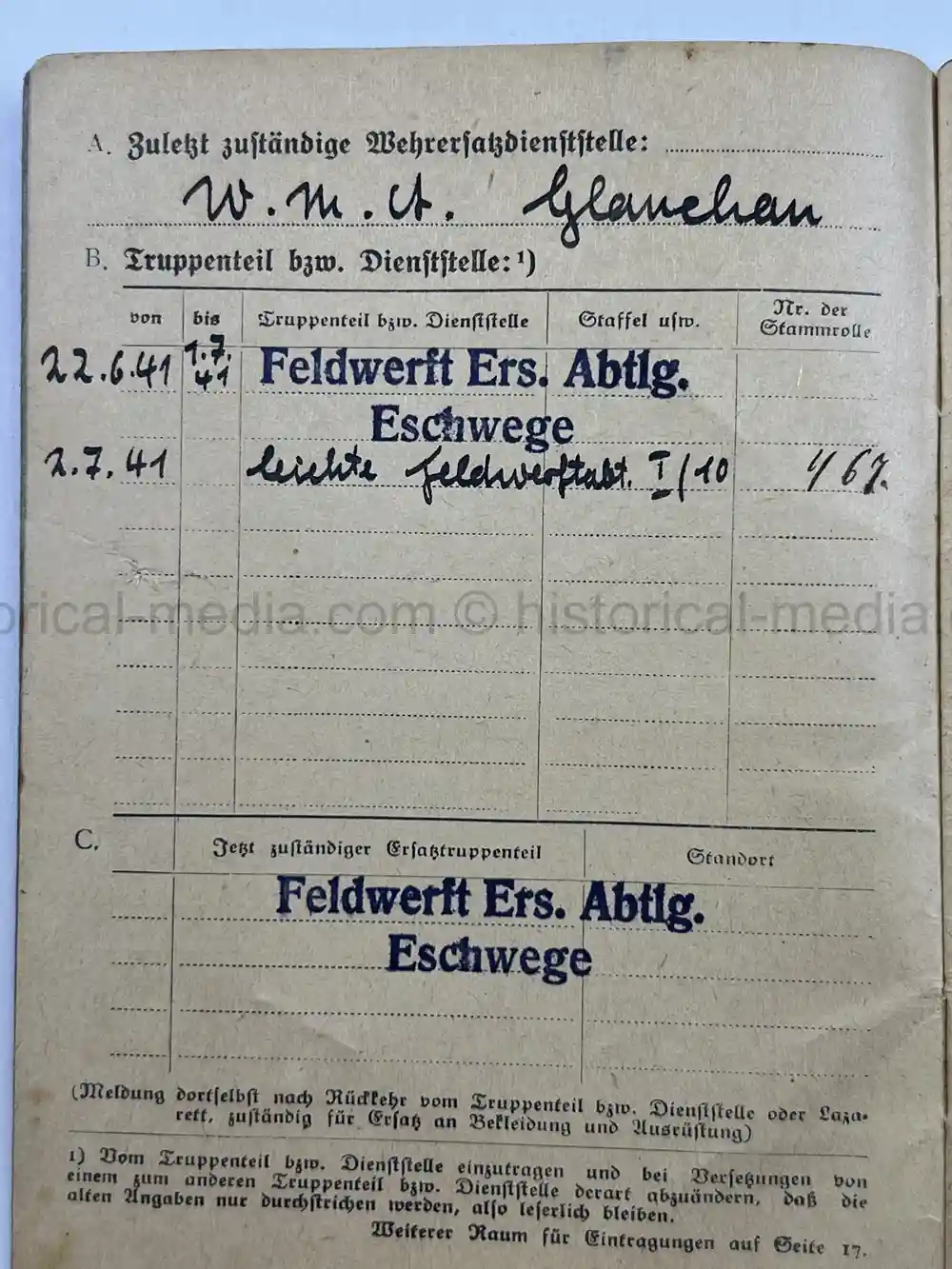
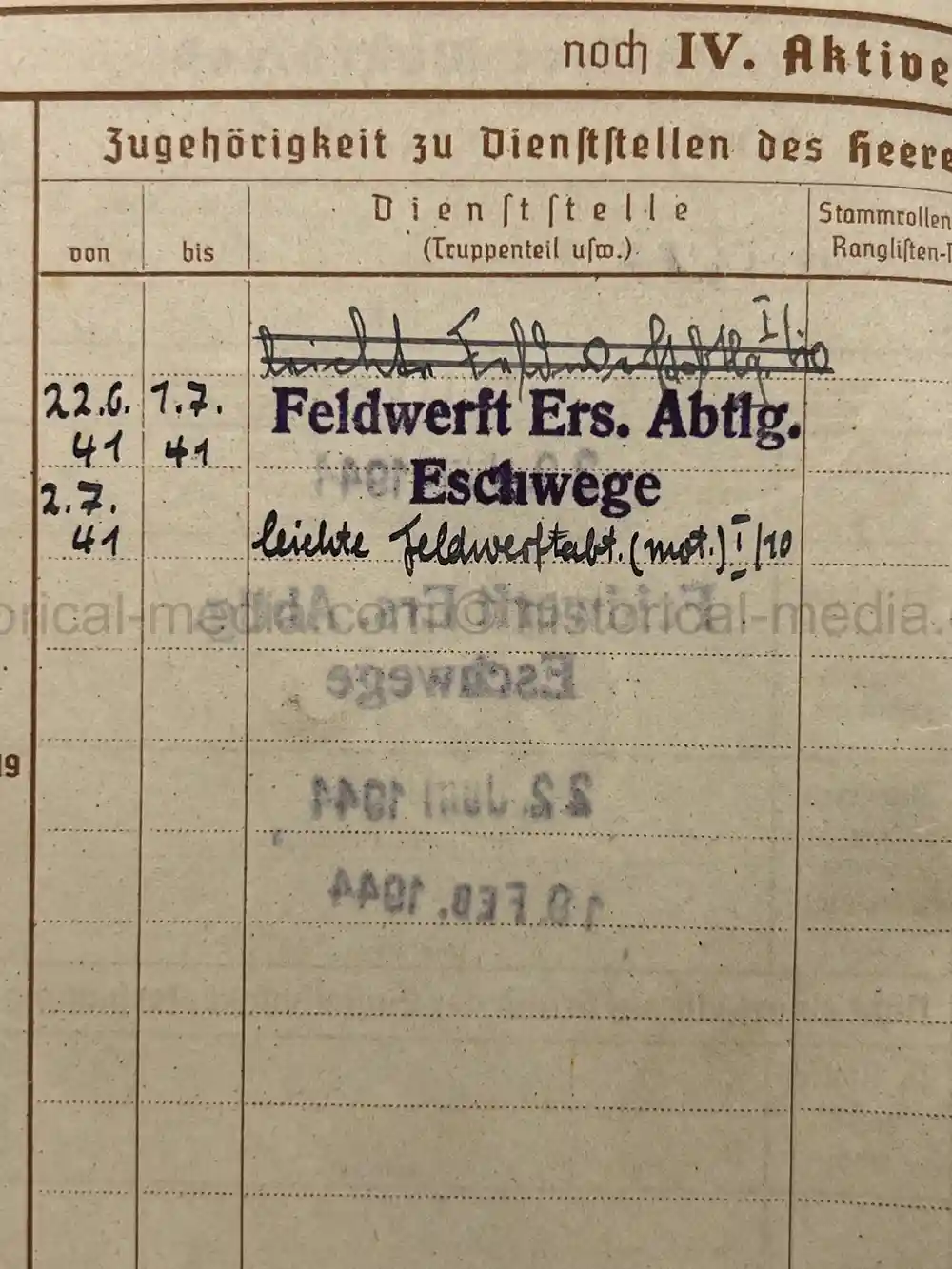
Soldbuch unit page (left) / Wehrpass unit table (right)
The Soldbuch lists Feldwerft-Ersatz-Abteilung Eschwege in the service table and again as the currently responsible replacement unit. It then names leichte Feldwerftabteilung I/40 as the service unit, while Eschwege remains responsible in the replacement section. The Wehrpass records the same sequence in its dated unit table.
What this comparison establishes
Eschwege’s repeated appearance does not create two simultaneous field postings. It illustrates actual earlier service and continuing replacement responsibility. These are Luftwaffe forms: the Soldbuch service record is B and replacement responsibility C, unlike the Heer C/D arrangement. The handwriting of the year figures and a mismatch with the Wehrpass entry-date stamp need owner review before a fully dated timeline is published.
Illustrated document: HEER STURMGESCHÜTZ SOLDBUCH – LEUTNANT – EK1 – 1./STURMGESCHÜTZ ABTEILUNG 209. Inventory examples may include sold items.
Waffen-SS comparison · field and replacement units (pages 4–5)
The page-4 headings distinguish the unit that sent the holder to the field army, the field unit, and the responsible replacement unit. Resek’s field-unit entry names the staff of 1. Kosaken-Division; the replacement entries identify an SS unit. The printed continuation points to page 25, rather than page 17 in the Heer example above. The facing page records next of kin. The red arrow belongs to the source photograph.
Original scan · click to translate
Translation table
Printed form labels from this Waffen-SS edition. Handwritten entries, signatures and stamps remain in the original.
| German printed text | English translation |
|---|---|
| A. Zuletzt zuständige Wehrersatzdienststelle | A. Last responsible recruiting office |
| B. Zum Feldheer abgesandt von | B. Sent to the Field Army by |
| Ersatztruppenteil | Replacement unit |
| Kompanie | Company |
| Nr. der Truppenstammrolle | Personnel-roll no. |
| C. | C. |
| Feldtruppenteil | Field unit |
| Nr. der Kriegsstammrolle | Wartime-roll no. |
| D. | D. |
| Jetzt zuständiger Ersatztruppenteil | Responsible replacement unit |
| Standort | Station |
| Meldung dort nach Rückkehr vom Feldheer oder Lazarett, Ersatz an Bekleidung und Ausrüstung | Report here on return from the field army or hospital; clothing and equipment replacement. |
| 1) Vom Ersatztruppenteil einzutragen, der den Soldbuchinhaber zum Feldheer abgesandt hat. | 1) Entered by the replacement unit sending the holder to the field army. |
| 2) Vom Feldtruppenteil einzutragen bei Versetzung von einem zum anderen Feldtruppenteil dort abzuändern, wobei die alten Angaben nur durchstrichen werden, so daß sie leserlich bleiben. | 2) Field unit to amend on transfer; cross out old entries so they remain legible. |
| Weiterer Raum für Eintragungen auf Seite 25. | Further entries on page 25. |
| Anschriften der nächsten lebenden Angehörigen | Addresses of nearest living relatives |
| des | Of |
| Vor- und Zuname | Given name / surname |
| 1. Ehefrau: Vor- und Mädchenname | 1. Wife: given / maiden names |
| gegebenenfalls Vermerk ledig | If applicable, enter unmarried |
| Wohnort (Kreis) | Residence (district) |
| Straße, Haus-Nr. | Street / house no. |
| 2. Eltern: des Vaters Vor- und Zuname | 2. Parents: father’s given / surname |
| Stand oder Gewerbe | Status / occupation |
| der Mutter Vor- und Mädchenname | Mother’s given / maiden names |
| 3. Verwandte oder Braut | 3. Relative or fiancée |
| Auszufüllen nur, wenn weder 1 noch 2 ausgefüllt sind. | Complete only if neither 1 nor 2 is filled in. |
Illustrated document: Walter Resek Soldbuch and document grouping.
ORIGINAL PAGE 5 · Heer; Heinz original-issue Soldbuch
Next of kin and addresses
Original scan · click to translate
English reading view
Translation of the visible printed fields; personal handwriting and stamps remain in the original scan.
| German printed text | English translation |
|---|---|
| Anschriften der nächsten lebenden Angehörigen: | Addresses of the nearest living relatives. |
| des / (Vor- und Zuname) | Of / (given name and surname of the holder). |
| 1. Ehefrau: Vor- und Mädchenname | 1. Wife: given name and maiden surname. |
| (ggf. Vermerk „ledig“) | (If applicable, enter “unmarried”.) |
| Wohnort (Kreis) / Straße, Haus-Nr. | Place of residence (district) / street and house number. Repeated for the relevant relatives. |
| 2. Eltern: des Vaters, Vor- und Zuname | 2. Parents: father’s given name and surname. |
| Stand oder Gewerbe | Status or occupation. |
| der Mutter, Vor- u. Mädchenname | Mother’s given name and maiden surname. |
| 3. Verwandte oder Braut: * | 3. Relative or fiancée. * |
| Vor- und Zuname | Given name and surname. |
| Stand oder Gewerbe | Status or occupation. Repeated in section 3. |
| * Ausfüllung nur, wenn weder 1. noch 2. ausgefüllt sind. | * Complete only if neither section 1 nor section 2 has been completed. |
How this page was used
The form records contact details for the wife, parents or, where neither of those sections is completed, another relative or fiancée. The footnote governs section 3; it is not an instruction to add every possible relative.
How to read it
The printed order matters: wife, parents, and only where the earlier categories are not completed, another relative or fiancée. A relative’s address is a family contact, not a posting or home garrison. “Mädchenname” records a maiden surname. Changes of family circumstances or address should be checked against the dates and opening personal particulars rather than used alone to infer a service move.
The illustrated example
The Heinz page shows the wife’s and parents’ details, with the third section left unused. This illustrates the structure of the printed instruction without needing to translate the family addresses.
Illustrated document: HEER STURMGESCHÜTZ SOLDBUCH – LEUTNANT – EK1 – 1./STURMGESCHÜTZ ABTEILUNG 209. Inventory examples may include sold items.
ORIGINAL PAGE 6-7 · Heer; Heinz expanded clothing sheet, printed 6-7
Clothing and equipment - expanded record sheet
Original scan · click to translate
English reading view
Translation of the visible printed fields; personal handwriting and stamps remain in the original scan.
| German printed text | English translation |
|---|---|
| Nachweis über Bekleidungs- und Ausrüstungsstücke | Record of clothing and equipment items. |
| Truppenteil | Unit. |
| Feldmütze | Field cap. |
| Feldbluse (Feldjacke) | Field tunic (field jacket). |
| Drillichzeug | Drill clothing. |
| Arbeitsanzug | Work clothing. |
| Tuch-, Reit- oder Feldhose | Cloth, riding or field trousers. |
| Unterhose | Underpants. |
| Mantel / Übermantel | Greatcoat / overcoat. |
| Schutzmantel | Protective coat. |
| Kragenbinde | Collar liner. |
| Hemd | Shirt. |
| Schlupfjacke | Pullover jacket. |
| Kopfschützer | Head protector / protective hood. |
| Handschuhe / Überhandsch. | Gloves / overmittens. |
| Überstrümpfe | Overstockings. |
| Socken/Fußlappen | Socks / foot wraps. |
| Marsch-, Reitstiefel | Marching boots / riding boots. |
| Schnürschuhe | Lace-up shoes or boots. |
| Laufschuhe | Running shoes. |
| Filzschuhe | Felt shoes. |
| Leibbinde | Waist wrap. |
| Stahlhelm | Steel helmet. |
| Tornister (Gefechtsgepäck) | Pack (combat pack). |
| Bekleidungssack | Clothing bag. |
| Packtasche | Pack bag / pannier. |
| Fettbüchse | Fat container. |
| Zeltausrüstung | Shelter-tent equipment. |
| Koppel mit Zubehör | Belt with accessories. |
| Mantelriemen | Greatcoat straps. |
| Brotbeutel mit Band | Bread bag with strap. |
| Feld- (Labe-)flasche | Field / drinking bottle. |
| Portepee (Faustriemen) | Sword knot (wrist strap). |
| Patronentasche | Cartridge pouch. |
| Anschnallspor. mit Riemen | Strap-on spurs with straps. |
| Kochgeschirr | Mess tin. |
| Meldekartentasche | Message / map case. |
| Signalpfeife | Signal whistle. |
| Handtuch | Towel. |
| Eßbesteck | Eating utensils. |
| Sonnen- (Schutz-) Brille | Sunglasses / protective goggles. |
| Taschentuch | Handkerchief. |
| Bürsten | Brushes. |
| Hosenträger | Braces / suspenders. |
| Decke | Blanket. |
| Namenszeichen des Ausgebenden und Empfängers / Datum | Initials of the issuer and recipient / date. |
| Anmerkung: Stücke, die nicht vorgedruckt sind, sind in freie Spalten einzutragen. Vorhandene Spalten können auch berichtigt werden, z. B. „Rucksack“ statt „Tornister“, „Berghose“ statt „Tuchhose“. Alle Änderungen sind durch Namenszeichen zu bescheinigen. | Note: Items not preprinted are to be entered in empty columns. Existing columns may also be amended, e.g. “rucksack” instead of “pack”, “mountain trousers” instead of “cloth trousers”. All changes are to be certified by initials. |
How this page was used
Quantities are entered against the clothing and equipment headings, while the issuing and receiving parties certify the entries. The printed note expressly permits added items and amended headings; handwritten column names therefore need to be distinguished from the original form.
How to read it
Read a clothing issue across the table, linking quantities to the named unit and dated receipt or initials. This is an administrative record of items issued, replaced or returned, not a complete photograph of everything the soldier wore on one day. Added headings are important: the printed instruction explicitly allowed alternative items to be written into spare columns or substituted for existing labels.
The illustrated example
The Heinz book contains both older clothing tables and this expanded sheet. It provides a useful comparison of form layouts and shows items added in columns beyond the printed headings.
Reading notes and open questions
- The pack-column wording is partly overwritten; “Tornister (Gefechtsgepäck)” is a provisional reading for owner confirmation.
- Older clothing-table inserts in this book have a different set of columns. Their full transcription is still needed; this record translates the expanded sheet only.
Illustrated document: HEER STURMGESCHÜTZ SOLDBUCH – LEUTNANT – EK1 – 1./STURMGESCHÜTZ ABTEILUNG 209. Inventory examples may include sold items.
ORIGINAL PAGE 8 · Heer; Heinz original-issue Soldbuch
Besondere Bekleidungsvermerke - clothing remarks
Original scan · click to translate
English reading view
Translation of the visible printed fields; personal handwriting and stamps remain in the original scan.
| German printed text | English translation |
|---|---|
| Besondere Bekleidungsvermerke | Special clothing remarks. |
| (z. B. Antrag der Feldeinheit auf Umtausch von Sachen usw.) | (For example: request by the field unit for exchange of items, etc.) |
| Nach Erledigung vorseitige Eintragungen in rot ändern. | Once dealt with, amend the entries on the preceding pages in red. |
How this page was used
This page supplements the item-by-item clothing tables. Its instruction links a clothing request or remark with amendments to the preceding record once the matter has been dealt with.
How to read it
This remarks page accompanies the clothing tables. It could record requests for exchange or exceptional issue details that did not fit the quantity columns. The instruction to amend the preceding pages in red after dealing with a matter links a remark with the completed action. Read the remark and its dated certification together with pages 6-7, rather than treating it as a separate clothing inventory.
The illustrated example
The Heinz example has handwritten equipment remarks and a dated paymaster’s certification. Those additions are not part of the preprinted wording.
Illustrated document: HEER STURMGESCHÜTZ SOLDBUCH – LEUTNANT – EK1 – 1./STURMGESCHÜTZ ABTEILUNG 209. Inventory examples may include sold items.
ORIGINAL PAGE 8a · Heer; Engelbert Sick weapons insert, printed page 8a
Weapons and equipment record - specified items
Original scan · click to translate
English reading view
Translation of the visible printed fields; personal handwriting and stamps remain in the original scan.
| German printed text | English translation |
|---|---|
| Besitznachweis über Waffen und Gerät | Record of possession of weapons and equipment. |
| H. M. 1940 Nr. 205 | H. M. 1940, no. 205 (printed regulatory reference). |
| Waffen- oder Gerätart | Type of weapon or equipment. |
| Fertigungszeichen / Fertigungsnummer | Manufacturer’s mark / manufacturing or serial number. |
| Tag des Empfangs | Date received. |
| Namenszeichen des Gerätverwalters | Initials of the equipment custodian. |
| Gewehr | Rifle. |
| Pistole | Pistol. |
| Seitengewehr / Sabel | Bayonet / sabre. The added or overprinted Sabel wording is retained as seen. |
| Marschkompaß | Marching compass. |
| Doppelfernrohr | Binoculars. |
| Klapphacke | Folding pick / hoe. |
| Spaten | Spade. |
| Klauenbeil | Claw hatchet. |
How this page was used
This issue record lists specified weapons, tools and optical equipment, with space for the maker’s mark, serial number, date received and the equipment custodian’s initials. A row identifies an issued item; it is not a weapons-training qualification.
How to read it
The item’s model or type, maker’s mark and serial number belong to the object. They should not be read as another service number for the soldier. Crossed-out numbers can record a returned or replaced item. An issue date can help anchor a unit timeline when the issuing authority is identified, but the issue record alone does not establish the holder’s combat role.
The illustrated example
Engelbert Sick’s clearer page replaces the gutter-obscured Heinz image for the form translation. The rifle entry includes a later cancellation, while tools have their own rows. The added “Abgegeben” wording means handed back / returned; it is an entry, not a printed heading.
Illustrated document: SOLDBUCH – ENGELBERT SICK – (SF.) PANZER-ARTILLERIE-REGIMENT 27 – 17. PANZER-DIVISION – EASTERN FRONT – WESPE / HUMMEL . Inventory examples may include sold items.
ORIGINAL PAGE 8b · Heer; Engelbert Sick weapons insert, printed page 8b
Weapons and protective equipment - page 8b
Original scan · click to translate
English reading view
Translation of the visible printed fields; personal handwriting and stamps remain in the original scan.
| German printed text | English translation |
|---|---|
| Besitznachweis über Waffen und Gerät | Record of possession of weapons and equipment. |
| H. M. 1940 Nr. 205 | H. M. 1940, no. 205 (printed regulatory reference). |
| Waffen- oder Gerätart | Type of weapon or equipment. |
| Fertigungszeichen / Fertigungsnummer | Manufacturer’s mark / manufacturing or serial number. |
| Tag des Empfangs | Date received. |
| Namenszeichen des Gerätverwalters | Initials of the equipment custodian. |
| Drahtschere | Wire cutters. |
| Reinigungsgerät 34 | Cleaning kit 34. |
| Gasmaske | Gas mask. |
| Maskenbrille | Spectacles for use with the gas mask. |
| Watte und Vaseline (Salbe) für Trommelfellverletzte | Cotton wool and petroleum jelly (ointment) for men with eardrum injuries. |
How this page was used
The second leaf continues the possession record with cleaning equipment, the gas mask and accessories. Its final printed category provides for materials for men with eardrum injuries.
How to read it
Maskenbrille were spectacles intended to work with the gas mask, distinct from the ordinary spectacle prescription on pages 10-11. The special printed provision for men with eardrum injuries is an equipment entitlement, not proof that every holder of this form had such an injury. Only an actual entry, supported by the medical record, establishes its application to the man.
The illustrated example
Sick’s page has numbered equipment entries and additional items written into the spare rows. The new scan establishes what was hidden in the earlier source set.
Illustrated document: SOLDBUCH – ENGELBERT SICK – (SF.) PANZER-ARTILLERIE-REGIMENT 27 – 17. PANZER-DIVISION – EASTERN FRONT – WESPE / HUMMEL . Inventory examples may include sold items.
ORIGINAL PAGE 8c · Heer; Heinz original-issue Soldbuch
Weapons and equipment - additional items
Original scan · click to translate
English reading view
Translation of the visible printed fields; personal handwriting and stamps remain in the original scan.
| German printed text | English translation |
|---|---|
| Besitznachweis über Waffen und Gerät | Record of possession of weapons and equipment. |
| H. M. 1940 Nr. 205 | H. M. 1940, no. 205 (printed regulatory reference). |
| Waffen- oder Gerätart | Type of weapon or equipment. |
| Fertigungszeichen / Fertigungsnummer | Manufacturer’s mark / manufacturing or serial number. |
| Tag des Empfangs | Date received. |
| Namenszeichen des Gerätverwalters | Initials of the equipment custodian. |
How this page was used
The same identifying columns continue on a less prescriptive sheet, allowing additional weapons or equipment to be recorded without limiting the entry to the named items on 8a.
How to read it
The less prescriptive table allowed additional items to be entered. Heinz’s private-pistol statement is a useful contrast with ordinary issued equipment: it records personal acquisition rather than making every pistol row a private purchase. Read any declaration, calibre, number and certification exactly as entered; do not infer a manufacturer or model from calibre alone.
The illustrated example
This Heinz leaf carries a statement concerning a privately purchased 7.65 mm pistol. It is useful as an entered example of personal ownership; that statement is not part of the blank printed form.
Reading notes and open questions
- Two different photographed leaves in the gallery appear to carry the designation 8c. The companion image is 20250421-1182.webp. Confirm the insert sequence and whether one is a duplicated/additional leaf before final numbering.
Illustrated document: HEER STURMGESCHÜTZ SOLDBUCH – LEUTNANT – EK1 – 1./STURMGESCHÜTZ ABTEILUNG 209. Inventory examples may include sold items.
ORIGINAL PAGE 8d · Heer; Heinz original-issue Soldbuch
Weapons insert - further reverse side
Source scan needed
This page is included in the book’s page map. A suitable scan is still needed before its printed fields can be translated.
How this page was used
A separate reference slot is retained for this insert side, without assuming that the selected book contains a particular printed version.
Reading notes and open questions
- A clearly numbered 8d view has not yet been identified. Check the insert sequence against the original book or another complete inventory example.
Illustrated document: HEER STURMGESCHÜTZ SOLDBUCH – LEUTNANT – EK1 – 1./STURMGESCHÜTZ ABTEILUNG 209. Inventory examples may include sold items.
ORIGINAL PAGE 9 · Heer; Heinz original-issue Soldbuch
Impfungen - vaccination record
Original scan · click to translate
English reading view
Translation of the visible printed fields; personal handwriting and stamps remain in the original scan.
| German printed text | English translation |
|---|---|
| Impfungen gegen | Vaccinations against. |
| am | On [date]. Repeated for each vaccination category. |
| a) Pocken / Erfolg | a) Smallpox / result. |
| b) Typhus / Paratyphus | b) Typhoid fever / paratyphoid fever. |
| ccm | Cubic centimetres (dose volume). |
| c) Ruhr | c) Dysentery. |
| d) Cholera | d) Cholera. |
| e) Sonstige Schutz- und Heilimpfungen | e) Other preventive and therapeutic vaccinations. |
How this page was used
The form separates disease categories, vaccination dates, dose volumes and the result of smallpox vaccination. The German medical term Typhus in this context is translated as typhoid fever, not automatically as the English disease name “typhus”.
How to read it
The diseases have separate columns, and the same course may include several dates. The Pocken “Erfolg” entry is the recorded result of vaccination; it is not a diagnosis of smallpox. Typhus in this vaccination context refers to typhoid fever, whereas Fleckfieber is a separate German disease term. Vaccination dates alone are insufficient to place the soldier in a particular theatre.
The illustrated example
The Heinz page shows entries over several years. It can illustrate repeated inoculations without using the vaccination dates alone to infer a particular posting.
Illustrated document: HEER STURMGESCHÜTZ SOLDBUCH – LEUTNANT – EK1 – 1./STURMGESCHÜTZ ABTEILUNG 209. Inventory examples may include sold items.
ORIGINAL PAGE 10 · Heer; Rudolf Schelenz spectacle form, printed page 10
Spectacle prescription - frame fit and spherical lenses
Original scan · click to translate
English reading view
Translation of the visible printed fields; personal handwriting and stamps remain in the original scan.
| German printed text | English translation |
|---|---|
| Tag der Brillenbestimmung | Date of the spectacle prescription / assessment. |
| 1 - 2 Brillen *) | One - two pairs of spectacles. * |
| Höhe der Nasenwurzel über dem Hornhautscheitel ... mm | Height of the root of the nose above the corneal apex ... millimetres. |
| Gestell-Nr. | Frame number. |
| Kugelförmig geschliffen (sphärisch) | Spherically ground (spherical correction). |
| rechts / links | Right / left. |
| - Glas / + Glas | Minus lens / plus lens. |
| BKE | Refractive-power units (dioptres); the abbreviation is explained on page 11. |
| *) Nichtzutreffendes durchstreichen. | * Cross out whichever does not apply. |
How this page was used
This is the first half of the spectacle prescription. It records the examination date, number of pairs, frame information and spherical correction for each eye. Page 11 continues with pupil-position measurements and cylindrical correction.
How to read it
Read the right and left eyes separately and retain the plus or minus sign: they are part of the correction, not decoration around a number. Gestell-Nr. identifies the spectacle frame. The instruction below the one-or-two-pairs choice tells the clerk to cross out the inapplicable option. The blank optical fields in Schelenz’s example should not be filled from the unrelated handwritten certification below.
The illustrated example
The optical form on Schelenz’s page is unused, but the spare space contains a separate medical certification. The handwritten certification is not an optical prescription and does not change the meaning of the printed lens fields.
Illustrated document: AFRIKAKORPS SOLDBUCH – RUDOLF SCHELENZ –INFANTERIE-LEHR-REGIMENT – LEHR BRIGADE (MOT.) 900 – AFRIKA (PANZER A.O.K. 5) – EXCHANGED POW . Inventory examples may include sold items.
ORIGINAL PAGE 11 · Heer; Heinz original-issue Soldbuch
Spectacle measurements and replacement instruction
Original scan · click to translate
English reading view
Translation of the visible printed fields; personal handwriting and stamps remain in the original scan.
| German printed text | English translation |
|---|---|
| Abstand der Sehlochmitte (beim Blick in die Ferne): | Distance of the centre of the visual aperture [pupil centre] when looking into the distance. |
| rechts / links / mm | Right / left / millimetres. |
| Längsgeschliffen (zylindrisch) | Cylindrically ground [cylindrical correction]. |
| Glas / Achse | Lens / axis. |
| BKE / Grad | Refractive-power units / degrees. |
| BKE = Brechkrafteinheit (Dioptrie) | BKE = unit of refractive power (dioptre). |
| Ersatz für zerbrochene Gläser, abgenutzte Bänder und verlorene Brillen ist zu verlangen durch den Truppenarzt unter Vorlage des Soldbuches. | Replacement of broken lenses, worn straps and lost spectacles is to be requested through the unit medical officer, presenting the Soldbuch. |
How this page was used
This page records optical measurements and cylindrical correction, and explains the route for replacing spectacles or their parts. It should be read with page 10 for the complete prescription.
How to read it
The right/left measurements and the lens/axis fields are different kinds of information. Cylindrical correction requires both a strength and an axis; neither should be substituted for the spherical value on page 10. BKE is explained on the form as a dioptre. The replacement instruction directs requests for broken lenses, worn straps or lost spectacles through the Truppenarzt (unit medical officer).
The illustrated example
The chest X-ray entry dated March 1944 is an added stamp on Heinz’s page; it is deliberately excluded from the printed-form translation.
Reading notes and open questions
- Confirm the preferred technical English rendering of “Sehlochmitte” and “Längsgeschliffen” with the owner. The literal terminology is retained alongside the explanatory rendering.
Illustrated document: HEER STURMGESCHÜTZ SOLDBUCH – LEUTNANT – EK1 – 1./STURMGESCHÜTZ ABTEILUNG 209. Inventory examples may include sold items.
ORIGINAL PAGE 12-13 · Heer; Heinz original-issue Soldbuch
Military-hospital admissions and discharges
Original scan · click to translate
English reading view
Translation of the visible printed fields; personal handwriting and stamps remain in the original scan.
| German printed text | English translation |
|---|---|
| Nachweisung über etwaige Aufnahme in ein Standort-, Feld-, Kriegs- oder Reservelazarett | Record of any admission to a garrison, field, war or reserve military hospital. |
| Lazarett | Military hospital. |
| Tag und Monat / Jahr der Laz.-Aufnahme | Day and month / year of admission to the military hospital. |
| Krankheit | Illness / medical condition. |
| Unterschrift des absendenden Truppenteils (Hauptmann usw. Oberfeldwebel) | Signature on behalf of the sending unit (Hauptmann, etc.; Oberfeldwebel). |
| Tag und Monat / Jahr der Entlassung aus dem Lazarett | Day and month / year of discharge from the military hospital. |
| Etwaige Bemerkung in Bezug auf die Entlassung aus dem Lazarett (übergeführt nach [placeholder], als geheilt zum Truppenteil usw.) | Any remarks concerning discharge from the military hospital (transferred to [destination], returned healed to the unit, etc.). |
| Unterschrift des die Entlassung bewirkenden Lazarettbeamten | Signature of the hospital official effecting the discharge. |
| Mitgegebene Wertsachen und Papiere siehe folgende Seiten! | For accompanying valuables and papers, see the following pages. |
How this page was used
The hospital spread follows a serviceman through admission, treatment, transfer and discharge. It identifies the Lazarett and admission date on the left; the date, destination or outcome of discharge and its certification are on the right. The Krankheit column can contain a diagnosis in words or a Krankennachweisnummer (medical reporting code). One wound could generate several rows as the patient moved between hospitals.
How to read it
Match each admission with its discharge on the same horizontal line, allowing for continuations and overlapping stamps. “Verlegt in ein anderes Lazarett” means transferred to another military hospital; it does not mean fit for front-line duty. Compare a destination with the unit responsibility on pages 4/17 and, if available, the wound record in the same man’s Wehrpass. A Wound Badge date belongs to the awards record and is not automatically the date of injury.
The illustrated example
Heinz’s diagnosis column repeatedly reads 31b. It also contains Trommelfellzerreißung (rupture of the eardrum), followed by a separate notation that is not securely deciphered. The entries therefore offer both a written diagnosis and coded records. The hospital dates must not automatically be counted as dates of separate wounds.
Reading notes and open questions
- The written diagnosis Trommelfellzerreißung is readable. Confirm the following small notation before assigning it a number or meaning. The discharge-heading placeholder previously read as “III.” is not treated as a medical category.
- Code-version checks: 31b has narrower/broader reference glosses; 31e needs original-regulation verification. Code 34 must not automatically be treated as self-inflicted injury. The small notation following the eardrum diagnosis is still unresolved.
Wound and illness codes - reading Heinz’s entries
31b in this example
Heinz’s hospital record repeatedly reads 31b, alongside a written eardrum diagnosis. The lettered reference keys associate 31b with grenade wounds, sometimes using a wider fragment category. It does not establish the precise weapon, injury site or severity. Several hospital rows may trace one injury through successive hospitals.
Different medical numbering systems
The hospital Krankennachweisnummern must be distinguished from the separate Fehlertabelle used for fitness assessment. Do not decode an unclear number by taking whichever list produces a plausible diagnosis. The small notation after Trommelfellzerreißung remains unresolved.
Scope of the lookup tables
The following key includes all 36 numbered wartime hospital groups, followed by the reported 31a-31e subdivisions. German terms are concise lookup labels, not extra printed wording on Heinz’s page. The base key applies to the 1939-1945 classification for the Wehrmacht excluding the Kriegsmarine; it is not a claim that all branches and dates used identical subcodes.
Hospital wound and illness codes - complete numbered key
All numbered groups 1-36. Some categories are broad; preserve any additional written diagnosis. Numbering cross-checked against the German 1953 government key reproduced in appendix 10.4 of the RWTH handbook.
| CODE / GERMAN LOOKUP LABEL | ENGLISH MEANING |
|---|---|
| 1 - Typhus / Paratyphus | Typhoid and paratyphoid fever (not epidemic typhus). |
| 2 - Ruhr | Dysentery. |
| 3 - Mandelentzündung | Tonsillitis. |
| 4 - Cholera | Cholera. |
| 5 - Pocken | Smallpox. |
| 6 - Masern / Scharlach / Diphtherie | Measles, scarlet fever and diphtheria. |
| 7 - Grippe | Influenza. |
| 8 - Fleckfieber | Epidemic typhus. |
| 9 - Malaria | Malaria. |
| 10 - Tuberkulose: Lunge / Brustfell | Tuberculosis of the respiratory organs and pleura. |
| 11 - Tuberkulose: andere Organe | Tuberculosis affecting other organs; not a general pleurisy code. |
| 12 - Sonstige Infektionskrankheiten | Other infectious diseases. Injury-related sepsis, erysipelas, gas gangrene and tetanus were assigned under 31 or 34 according to cause. |
| 13 - Tripper | Gonorrhoea. |
| 14 - Syphilis | Syphilis. |
| 15 - Sonstige Geschlechtskrankheiten | Other venereal diseases. |
| 16 - Stoffwechsel / Konstitution / Hormondrüsen / Tumoren | Metabolic and constitutional disorders, endocrine-gland diseases and tumours. |
| 17 - Blut / Lymphe / Kreislauf | Diseases of blood, blood-forming organs, lymphatic system and circulation. |
| 18 - Lungenentzündung | Pneumonia. |
| 19 - Sonstige Atemwegserkrankungen | Other respiratory diseases, excluding tuberculosis. |
| 20 - Zähne / Zahnhalteapparat | Diseases of teeth and supporting tissues. |
| 21 - Darm- / Magen-Darm-Katarrh | Enteritis and gastroenteritis. |
| 22 - Sonstige Verdauungsorgane | Other digestive-system diseases. |
| 23 - Nierenentzündung | Nephritis. |
| 24 - Harn- / Geschlechtsorgane, nicht venerisch | Other non-venereal urinary and genital diseases. |
| 25 - Haut / Hautanhänge / Unterhaut | Diseases of skin, its appendages and subcutaneous tissue. |
| 26 - Nerven / Psyche | Neurological and psychiatric conditions. |
| 27 - Augen | Eye diseases. |
| 28 - Ohren | Ear diseases. |
| 29 - Knochen / Bewegungsapparat | Bone and locomotor-system diseases. |
| 30 - Muskel- / Gelenkrheumatismus | Muscular and joint rheumatism. |
| 31 - Feindeinwirkung | Wounds and illnesses resulting from enemy action; see lettered subdivisions below. |
| 32 - Sonnenstich / Hitzschlag | Sunstroke and heatstroke. |
| 33 - Erfrierung / Frostschäden | Frostbite and other cold injury. |
| 34 - Unfallverletzung | Accidental injury, excluding enemy action and self-injury in the 1953 German key. Some collector summaries give a wider definition; do not infer self-harm from 34 alone. |
| 35 - Körperschwäche / angeborene Fehlbildung | General bodily weakness and congenital malformations. |
| 36 - Beobachtung / Krankheitsvortäuschung | Observation and suspected feigning of illness. An observation entry alone does not prove deception. |
Wound codes - reported lettered subdivisions
Keep the letter with the number. These lettered subdivisions come from reference keys and are not separately enumerated in the reproduced 1953 base table. 31e and the precise scope of 31b remain verification points.
| CODE / GERMAN LOOKUP LABEL | ENGLISH MEANING / QUALIFICATION |
|---|---|
| 31a - Geschossverletzung | Bullet/projectile wounds. |
| 31b - Granatverletzung / Splitter | Grenade wounds; some reference keys include mortar and artillery fragments. The code alone does not identify the exact weapon. |
| 31c - Verbrennung | Burns. |
| 31d - Bombenverletzung | Bomb/air-attack injuries. |
| 31e - Luftkampf | Air-combat injury: reported in collector reference tables; exact original-regulation scope still needs verification. |
Hospital code groups and distinction from fitness numbers: RWTH handbook, pp. 326-330
Diagnosis codes and fitness findings: two different keys
Start with the document field
The Soldbuch hospital illness column and a Wehrpass medical-examination note do not necessarily use the same numbering system. Identify the heading and purpose before looking up a number. The hospital code describes the reporting category for treatment; the separate Fehlertabelle classifies findings considered during a fitness examination.
A practical comparison
In the hospital key, 28 concerns ear disorders. In the separate medical-defect table, 28 concerns colour vision, while 31 concerns deafness and 32 ear disease. A bare number taken from the wrong table can therefore produce an entirely different interpretation. Preserve any letter, Roman numeral or other qualifier attached to the number.
A finding is different from a fitness decision
The number identifies a finding or category; the accompanying decision such as k.v. states the recorded fitness assessment. Neither supplies a complete clinical history. On Wehrpass page 35, Nachträge can include later examinations and reassessments; Diesing’s death entry illustrates another use of the supplementary space.
Applying the key to Heinz
The hospital entries read 31b, with a separate written eardrum diagnosis. The small additional notation remains unclear. Its position and full handwriting must be established before consulting either numerical key; the new reference does not justify assigning it a diagnosis by resemblance alone.
Independent German classification cross-check, appendix 10.4
Illustrated document: HEER STURMGESCHÜTZ SOLDBUCH – LEUTNANT – EK1 – 1./STURMGESCHÜTZ ABTEILUNG 209. Inventory examples may include sold items.
ORIGINAL PAGE 14 · Heer; Heinz original-issue Soldbuch
Money and valuables accompanying the holder
Original scan · click to translate
English reading view
Translation of the visible printed fields; personal handwriting and stamps remain in the original scan.
| German printed text | English translation |
|---|---|
| In das Lazarett mitgegeben: | Taken along to the military hospital. |
| Geld, geldwerthabende Papiere, Wertgegenstände u. dergl. | Money, securities or papers of monetary value, valuables and similar items. |
How this page was used
The printed heading provides space for money, valuable papers and other property accompanying the holder to hospital.
How to read it
The heading links valuables and papers to a hospital admission. A named possession belongs to this property record; its appearance here is not an equipment issue by the hospital. Read it with the adjacent admission and discharge information and any later receipt, release or correction. Heinz’s entered watch illustrates the kind of personal property that could be identified separately.
The illustrated example
The Heinz page contains an entered watch record. The factory or serial details belong to that individual entry, not to the blank form.
Illustrated document: HEER STURMGESCHÜTZ SOLDBUCH – LEUTNANT – EK1 – 1./STURMGESCHÜTZ ABTEILUNG 209. Inventory examples may include sold items.
ORIGINAL PAGE 15 · Heer; Heinz original-issue Soldbuch
Valuables form used for later certifications
Original scan · click to translate
English reading view
Translation of the visible printed fields; personal handwriting and stamps remain in the original scan.
| German printed text | English translation |
|---|---|
| In das Lazarett mitgegeben: | Taken along to the military hospital. |
| Geld, geldwerthabende Papiere, Wertgegenstände u. dergl. | Money, securities or papers of monetary value, valuables and similar items. |
How this page was used
The printed heading repeats the hospital-property function of page 14. The entries added to this example use the space for dated certifications instead, so the guide separates the purpose printed on the page from its actual completed use.
How to read it
The preprinted heading repeats the hospital-property function, but this example’s actual use includes later official certifications. This distinction helps explain why a unit stamp can appear here without being a field-service posting. For a service timeline, record the date and what the stamp certifies, then compare the authority with pages 4/17 and the surrounding pay or medical entries.
The illustrated example
Several different unit or office stamps and signatures appear on the Heinz page. They provide possible cross-references to his unit record without changing the translation of the original heading.
Illustrated document: HEER STURMGESCHÜTZ SOLDBUCH – LEUTNANT – EK1 – 1./STURMGESCHÜTZ ABTEILUNG 209. Inventory examples may include sold items.
ORIGINAL PAGE 16 · Heer; Rudolf Schelenz dental form, printed page 16
Dental record
Original scan · click to translate
English reading view
Translation of the visible printed fields; personal handwriting and stamps remain in the original scan.
| German printed text | English translation |
|---|---|
| Zahnstation | Dental station. |
| Zahnersatz erhalten am | Dental prosthesis / replacement teeth received on. |
| + Fehlende Zähne / O Ersetzte Zähne | + Missing teeth / O Replaced teeth. |
| 8 7 6 5 4 3 2 1 | 1 2 3 4 5 6 7 8 | Tooth positions numbered outward from the centre on each side; repeated for the upper and lower jaws. |
| Unterschrift des Zahnarztes | Dentist’s signature. |
| Unterschrift des Tr.-Arztes | Unit medical officer’s signature. |
| Ausbesserungen am / in der Zahnstation | Repairs on [date] / at the dental station. Repeated for further repairs. |
| Bemerkungen | Remarks. |
| z. B. trägt seit ... eigenes Zahnersatzstück mit ... Zähnen im ... Kiefer. | For example: has worn his own dental prosthesis since ... with ... teeth in the ... jaw. |
How this page was used
This records dental replacements, missing and replaced teeth, and later repairs. The printed key distinguishes a missing tooth from a replacement. The upper and lower lines of the diagram refer to the two jaws, with teeth counted outward from the centre.
How to read it
The + and O symbols have an explicit printed meaning; an O is not merely a clerk circling a tooth number. Teeth are numbered away from the central division on both sides of each jaw. The form also separates issue of replacement teeth from later repair, with dates and the dental station. The dentist and unit medical officer have separate signature spaces.
The illustrated example
Schelenz’s page supplies the complete, unobstructed form that was not visible in the Conrady photograph. Its unused diagram is especially suitable for explaining the symbols before showing a completed dental example.
Illustrated document: AFRIKAKORPS SOLDBUCH – RUDOLF SCHELENZ –INFANTERIE-LEHR-REGIMENT – LEHR BRIGADE (MOT.) 900 – AFRIKA (PANZER A.O.K. 5) – EXCHANGED POW . Inventory examples may include sold items.
ORIGINAL PAGE 17 · Heer; Conrady continuation form
Continuation of the Heer unit record
Original scan · click to translate
English reading view
Translation of the visible printed fields; personal handwriting and stamps remain in the original scan.
| German printed text | English translation |
|---|---|
| Fortsetzung zu Seite 4 | Continuation of page 4. |
| B. Zum Feldheer abgesandt von: ¹ | B. Sent to the Field Army by: ¹ |
| Ersatztruppenteil | Replacement unit. |
| Kompagnie | Company. |
| Nr. der Truppenstammrolle | Unit personnel-roll number. |
| C. Feldtruppenteil ² | C. Field unit. ² |
| Kompagnie | Company. Repeated under section C. |
| Nr. der Kriegsstammrolle | Wartime personnel-roll number. |
| a / b / c | Successive entry lines, repeated in B and C. |
| D. Jetzt zuständiger Ersatztruppenteil ² | D. Replacement unit currently responsible. ² |
| Standort | Station / garrison. |
| (Meldung dortselbst nach Rückkehr vom Feldheer oder Lazarett, zuständig für Ersatz an Bekleidung und Ausrüstung) | (Report there upon return from the Field Army or a military hospital; responsible for replacement clothing and equipment.) |
| ¹ Vom Ersatztruppenteil einzutragen, von dem der Soldbuchinhaber zum Feldheer abgesandt wird. | ¹ To be entered by the replacement unit from which the Soldbuch holder is sent to the Field Army. |
| ² Vom Feldtruppenteil einzutragen und bei Versetzungen von einem zum anderen Feldtruppenteil derart abzuändern, daß die alten Angaben nur durchstrichen werden, also leserlich bleiben. | ² To be entered by the field unit and amended upon transfers from one field unit to another so that earlier entries are only crossed out, i.e. remain legible. |
How this page was used
This continues sections B, C and D from page 4. Both pages are needed when following a sequence of replacement and field-unit entries.
How to read it
This is additional room for the unit record, not a second independent service history. Read B, C and D together with the same letters on page 4. A continuation entry can belong between events on the earlier page; physical page order is not a guarantee of chronological order. Dates elsewhere in the book can help establish when a unit became relevant.
The illustrated example
The illustrated page is from Heinrich Conrady’s Soldbuch, not Heinz’s. It includes later Sturmgeschütz unit entries and a separately recorded replacement unit.
Illustrated document: HEER SOLDBUCH – LEUTNANT – STURMGESCHÜTZ ABTEILUNG 191 + STURMGESCHÜTZ BRIGADE 201, 397 – KAMPFGRUPPE BÜRG. Inventory examples may include sold items.
ORIGINAL PAGE 18-19 · Heer; Heinz original-issue Soldbuch
Entitlement and pay-group record
Original scan · click to translate
English reading view
Translation of the visible printed fields; personal handwriting and stamps remain in the original scan.
| German printed text | English translation |
|---|---|
| A. Auszufertigen durch Beamten der zuständigen Zahlmeisterei mit dessen Unterschrift, Dienststellung, Dienststelle, Datum und Beidrucken des Dienststempels über zustehende Gebührnisse. | A. To be completed by an official of the responsible pay office, with his signature, appointment, office, date and official stamp, concerning the pay and allowances to which the holder is entitled. |
| Gültig ab | Valid from. |
| erhält die Gebührnisse der | Receives the pay and allowances of: |
| Bescheinigung der Zahlmeisterei | Certification by the pay office. |
| Stellengruppe | Pay / position group. |
How this page was used
The form records entitlement and its effective date, certified by the responsible pay office. It is distinct from the record of individual payments entered by another pay office on pages 20-21.
How to read it
Gebührnisse are entitlements to pay and allowances; Stellengruppe identifies the relevant group. The effective date of entitlement can differ from the date a pay office certifies a correction. Compare a new pay group with the rank change on page 1 and its certification on page 3. The presence of an office’s stamp does not prove it made every payment for that whole period.
The illustrated example
The Heinz page shows successive Stellengruppe entries. They can be read with the rank entries on page 1, without treating every nearby stamp as a separate cash payment.
Illustrated document: HEER STURMGESCHÜTZ SOLDBUCH – LEUTNANT – EK1 – 1./STURMGESCHÜTZ ABTEILUNG 209. Inventory examples may include sold items.
ORIGINAL PAGE 20-21 · Heer; Heinz original-issue Soldbuch
Payments by another pay office
Original scan · click to translate
English reading view
Translation of the visible printed fields; personal handwriting and stamps remain in the original scan.
| German printed text | English translation |
|---|---|
| B. Auszufertigen durch Beamten fremder Zahlmeisterei mit Unterschrift über ausgezahlte Gebührnisbeträge. | B. To be completed and signed by an official of another pay office concerning pay and allowance amounts paid out. |
| Zugleich Mitteilung (Vordruck) an zuständige Zahlmeisterei nach A. | At the same time, send notification (on the prescribed form) to the responsible pay office under A. |
| am / für (Zeit) | On [date] / for [period]. |
| Erläuterungen | Explanatory remarks. |
| RM. / Rpf. | Reichsmark / Reichspfennig. |
How this page was used
The table records the date, the period covered, an explanation and the amount. Its instruction calls for notification to the responsible pay office, linking actual payments with the entitlement record under A.
How to read it
A fremde Zahlmeisterei is another pay office, rather than necessarily a new unit in which the holder served. “am” is the payment date; “für (Zeit)” is the period covered, so the dates answer different questions. RM and Rpf divide Reichsmark and Reichspfennig. The notification instruction connects this outside payment with the responsible pay office’s entitlement record.
The illustrated example
Heinz’s pages include hospital and ration-related stamps entered in the payment area. These are additions to the page, not extra printed headings.
Reading notes and open questions
- The opening instruction on Heinz’s page 20 is partly hidden by a loose slip; its complete reading was checked against Conrady’s photographed page 20, 20250331-0252.webp.
Illustrated document: HEER STURMGESCHÜTZ SOLDBUCH – LEUTNANT – EK1 – 1./STURMGESCHÜTZ ABTEILUNG 209. Inventory examples may include sold items.
ORIGINAL PAGE 22 · Heer; Heinz original-issue Soldbuch
Auszeichnungen - awards and inserted continuation
Original scan · click to translate
English reading view
Legible entered record. Unclear entries remain marked.
| Entered German record | English translation |
|---|---|
| 15.1.1943 - Eisernes Kreuz I. Klasse | 15 January 1943 - Iron Cross, First Class. |
| 17.8.1943 - Verwundetenabzeichen in Schwarz | 17 August 1943 - Wound Badge in Black. |
| verliehen durch | Awarded by. The following unit or command identifies the authority recorded for that award. |
Original scan · click to translate
English reading view
Legible entered record. Unclear entries remain marked.
| Entered German record | English translation |
|---|---|
| 1940 - Kriegsverdienstkreuz II. Klasse mit Schwertern | 1940 - War Merit Cross, Second Class with Swords. The full day/month needs confirmation. |
| 3.2.1942 - Eisernes Kreuz II. Klasse | 3 February 1942 - Iron Cross, Second Class. |
| 10.5.1942 - Dienstauszeichnung d. IV. Kl. | 10 May 1942 - Armed Forces Long Service Award, Fourth Class (four years). The abbreviated class reading remains for owner confirmation. |
| 1.8.1942 - Ostmedaille | 1 August 1942 - Eastern Front Medal (Medal for the Winter Campaign in the East 1941/42). |
How this page was used
When the original award page was full, an additional leaf was inserted to continue the record. This was common practice. Heinz’s added leaf continues the earlier awards with the Eisernes Kreuz I. Klasse and Verwundetenabzeichen in Schwarz. The handwritten Auszeichnungen heading identifies its purpose.
How to read it
Read the award designation, class, date and awarding or certifying authority as separate pieces of evidence. An EK II and an EK I are separate awards, not two spellings of the same class. Likewise the colour/class of a Verwundetenabzeichen is significant. A date of entry or certification is not automatically the day of the action or wound that led to the award. The added leaf continues the original full award page.
The illustrated example
The original printed page 22 carries the earlier awards. The inserted leaf carries the two later entries dated 15 January and 17 August 1943. Read them together as one continuing award record; the insert is not a separate type of award form.
Entered records · transcription and translation
| Entered German record | English translation |
|---|---|
| 15.1.1943 - Eisernes Kreuz I. Klasse | 15 January 1943 - Iron Cross, First Class. |
| 17.8.1943 - Verwundetenabzeichen in Schwarz | 17 August 1943 - Wound Badge in Black. |
| verliehen durch | Awarded by. The following unit or command identifies the authority recorded for that award. |
Reading notes and open questions
- Original award page: confirm the overwritten day/month of the 1940 Kriegsverdienstkreuz entry and the abbreviated IV. Klasse reading of the long-service award. The award identifications already supplied by the owner are preserved.
Illustrated document: HEER STURMGESCHÜTZ SOLDBUCH – LEUTNANT – EK1 – 1./STURMGESCHÜTZ ABTEILUNG 209. Inventory examples may include sold items.
Waffen-SS comparison · awards on page 30
Resek’s awards are recorded on page 30, rather than page 22 in the main Heer example. The last entry is dated 30 January 1945 and names the War Merit Cross, 2nd Class with Swords. The earlier entries and certifying stamps show how several awards could be carried into one record. The facing page begins leave exceeding five days. Read handwritten dates and signatures in the original; the toggle translates the printed form.
Original scan · click to translate
Translation table
Printed form labels from this Waffen-SS edition. Handwritten entries, signatures and stamps remain in the original.
| German printed text | English translation |
|---|---|
| Orden und Ehrenzeichen | Orders and decorations |
| Datum | Date |
| Art der Auszeichnung | Type of award |
| Urkunde erhalten | Certificate received |
| Bescheinigung (Komp.- usw. Führer) | Certification (company etc. commander) |
| Beurlaubungen über 5 Tage | Leave exceeding five days |
| Vom | From |
| bis | To |
| nach | To |
| Grund | Reason |
| den | Dated |
| Dienststempel | Official stamp |
| Unterschrift des Komp.-, Truppführers usw. | Signature of company / detachment commander |
Illustrated document: Walter Resek Soldbuch and document grouping.
ORIGINAL PAGE 23-24 · Heer; Heinz original-issue Soldbuch
Leave dates, destination and reason
Original scan · click to translate
English reading view
Translation of the visible printed fields; personal handwriting and stamps remain in the original scan.
| German printed text | English translation |
|---|---|
| Beurlaubungen über fünf Tage | Leave periods exceeding five days. |
| vom / bis / nach | From / to / destination. |
| Grund: | Reason. |
| den | Dated. |
| Dienststempel | Official stamp. |
| (Unterschrift des Komp.-, Truppenführers usw.) | (Signature of the company or unit commander, etc.) |
How this page was used
Each leave block separates its date range, destination, reason, authorisation date, official stamp and commander’s signature. The repeated blocks on the next page continue the same structure.
How to read it
Each block separates the authorised leave period, destination, reason and date of approval. “Erholungsurlaub” is recuperative/rest leave; “Genesungsurlaub” specifically concerns convalescence. A departure annotation or later extension must be read with the original dates. The approving unit can help identify who administered the holder at that point, but an ordinary leave destination is not a new posting.
The illustrated example
The Heinz page includes Erholungsurlaub entries and a crossed-out leave block. This is a useful example of why the authorised period and later amendments should be read together.
Reading notes and open questions
- The “vom” field at the extreme left of page 23 is clipped in the close-up; the continuation views and Conrady leave form show the full repeated structure.
Illustrated document: HEER STURMGESCHÜTZ SOLDBUCH – LEUTNANT – EK1 – 1./STURMGESCHÜTZ ABTEILUNG 209. Inventory examples may include sold items.
ORIGINAL PAGE Luftwaffe-4 · Luftwaffe; Bahner form
Luftwaffe unit-record comparison
Original scan · click to translate
English reading view
Translation of the visible printed fields; personal handwriting and stamps remain in the original scan.
| German printed text | English translation |
|---|---|
| A. Zuletzt zuständige Wehrersatzdienststelle: | A. Most recently responsible military recruiting office. |
| B. Truppenteil bzw. Dienststelle: ¹ | B. Unit or office. ¹ |
| von / bis | from / to |
| Truppenteil bzw. Dienststelle | Unit or office (repeated as the main table-column heading). |
| Staffel usw. | Squadron, etc. |
| Nr. der Stammrolle | Personnel-roll number. |
| C. Jetzt zuständiger Ersatztruppenteil | C. Replacement unit currently responsible. |
| Standort | Station / garrison. |
| (Meldung dortselbst nach Rückkehr vom Truppenteil bzw. Dienststelle oder Lazarett, zuständig für Ersatz an Bekleidung und Ausrüstung) | (Report there upon return from the unit or office, or from a military hospital; responsible for replacement clothing and equipment.) |
| ¹ Vom Truppenteil bzw. Dienststelle einzutragen und bei Versetzungen von einem zum anderen Truppenteil bzw. Dienststelle derart abzuändern, daß die alten Angaben nur durchstrichen werden, also leserlich bleiben. | ¹ To be entered by the unit or office and amended on transfers from one unit or office to another so that the previous entries are only crossed out, i.e. remain legible. |
| Weiterer Raum für Eintragungen auf Seite 17. | Further space for entries on page 17. |
How this page was used
This is the approved Luftwaffe comparison. Its unit history is in section B and replacement-unit responsibility in C, rather than the Heer B/C/D structure illustrated by Heinz.
How to read it
The Luftwaffe example has dated service periods in section B and replacement responsibility in C. Those letters differ from the Heer arrangement. In Bahner’s pair, Eschwege appears as a place of actual service and as the responsible replacement unit; the same name therefore has two functions. The matching Wehrpass supplies a second view of the service sequence rather than eliminating the need to read each heading.
The illustrated example
The same Eschwege replacement-unit stamp appears in two sections with different functions.
Reading notes and open questions
- The printed page number is outside the supplied photograph; the page-4 layout is identified by the form and surrounding gallery sequence.
Illustrated document: Bahner Soldbuch and Wehrpass grouping. Inventory examples may include sold items.
Guide text, translations and presentation © 2026 Historical Media, Inc. All rights reserved.