
HISTORICAL MEDIA · COLLECTOR REFERENCE
Explore original documents from our inventory, understand their wartime use, and read the printed German fields in English.
Click a scan to toggle its printed labels between German and English. Use Translation table for the full side-by-side text. Handwriting and stamps remain in the original. Source gaps and uncertain readings are marked.
ORIGINAL PAGE cover · Rehermann Wehrpass; Luftwaffe service
Wehrpaß - cover
Original scan · click to translate
English reading view
Translation of the visible printed fields; personal handwriting and stamps remain in the original scan.
| German printed text | English translation |
|---|---|
| Wehrpaß | Military service record book. |
Purpose of the Wehrpass
The Wehrpass was a military registration and service record, beginning before a man entered active service. It could record personal details, fitness and conscription decisions, labor service, training, units, promotions, campaigns and reserve status. Possession of a Wehrpass alone does not establish that its holder served at the front; the dated entries show what actually happened.
Soldbuch and Wehrpass: the difference
Before call-up, the holder kept his Wehrpass. On entering a unit he normally handed it in and received a Soldbuch, which he carried as his pay and identity document. The Wehrpass remained with the military administration, followed transfers and was normally returned on discharge. It was also distinct from the Wehrstammbuch, the recruiting authority’s separate master record. These overlapping records served different administrative purposes.
Development and variations
The system belongs to the expansion of German military registration around the restoration of compulsory service in 1935. Its scope extended from examination and induction through active service into the reserve. Prewar-issued books could remain in use during the war; later entries and supplementary pages extended the record. The examples in this guide show differences in lettering and printed fields, so compare the issue details and interior layout as well as the cover.
Historical background: U.S. War Department, The Exploitation of German Documents (1944), sections 8–9; The German Replacement Army (1944), “Record Keeping”. Bundesarchiv: Wehrgesetz und Wehrdienst 1935–1945.
The illustrated example
Josef Rehermann’s book supplies the main Luftwaffe service example. Dalitz and Diesing supply further Heer examples where they show the form more clearly.
Illustrated document: WEHRPASS – JAGDGESCHWADER 27 – EBEN EMAEL – AFRIKAKORPS – D-DAY – NORMANDY !. Inventory examples may include sold items.
ORIGINAL PAGE 1 · Rehermann Wehrpass; Luftwaffe service
Identity and registration numbers
Original scan · click to translate
English reading view
Translation of the visible printed fields; personal handwriting and stamps remain in the original scan.
| German printed text | English translation |
|---|---|
| Wehrnummer | Military registration number. |
| Name des Paßinhabers | Name of the holder. |
| (Rufname, Familienname) | (Given name used in everyday life; surname.) |
| Nummer der Kennkarte | Identity-card number. |
| Nummer des Arbeitsbuches | Employment-record book number. |
| Nummer der Erkennungsmarke (im Kriege) | Identity-disc number (in wartime). |
| (Dienstsitz des Wehrbezirkskommandos) | (Official seat of the military district recruiting command.) |
| den / (Tag, Monat, Jahr) | Dated / (day, month, year). |
| Dienststempel | Official stamp. |
| (Unterschrift und Dienstgrad, Dienststellung) | (Signature and rank; appointment.) |
How this page was used
These are distinct identifying numbers. The Wehrnummer, identity-card number, employment-book number and wartime identity-disc number do not mean the same thing.
How to read it
Keep each numbered document distinct. Wehrnummer identifies the military registration; Kennkarte and Arbeitsbuch refer to separate civilian identity and employment documents. Where a wartime Erkennungsmarke field is present, its disc inscription must be read as entered, rather than substituted for the latest unit. Earlier forms can lack that dedicated box and show an addition elsewhere.
The illustrated example
Rehermann’s form includes a wartime identity-disc field. The Diesing example has an earlier layout, with an identity-disc entry added in the employment-book area; that difference must not be silently normalised.
Illustrated document: WEHRPASS – JAGDGESCHWADER 27 – EBEN EMAEL – AFRIKAKORPS – D-DAY – NORMANDY !. Inventory examples may include sold items.
ORIGINAL PAGE 2 · Rehermann Wehrpass; Luftwaffe service
Portrait and holder’s signature
Original scan · click to translate
English reading view
Translation of the visible printed fields; personal handwriting and stamps remain in the original scan.
| German printed text | English translation |
|---|---|
| (Eigenhändige Unterschrift des Inhabers - Rufname, Familienname) | (Holder’s own signature - given name used in everyday life; surname.) |
How this page was used
The portrait and the holder’s own signature link the record to its owner. A portrait does not by itself date every entry in the book.
How to read it
The printed caption calls for the holder’s own signature, naming his Rufname and surname. Compare this with page 3 when several given names are listed. A civilian or uniform portrait is one dated piece of evidence within a longer record, rather than a guarantee that every later rank or decoration was already held when the photograph was taken.
The illustrated example
Diesing’s uniform portrait provides a useful alternative to the civilian portrait shown in the approved Dalitz sample. The signature wording is translated independently of the handwriting.
Illustrated document: WEHRPASS – JAGDGESCHWADER 27 – EBEN EMAEL – AFRIKAKORPS – D-DAY – NORMANDY !. Inventory examples may include sold items.
ORIGINAL PAGE 3 · Dalitz Wehrpass; approved personal-particulars form
Personal particulars - approved sample
Original scan · click to translate
English reading view
Translation of the visible printed fields; personal handwriting and stamps remain in the original scan.
| German printed text | English translation |
|---|---|
| I. Angaben zur Person. | I. Personal particulars. |
| 1. Familienname | 1. Surname. |
| 2. Vornamen | 2. Given names. |
| (Rufname unterstreichen) | (Underline the given name used in everyday life.) |
| 3. Geburtstag, -monat, -jahr | 3. Day, month and year of birth. |
| 4. Geburtsort | 4. Place of birth. |
| Verwaltungsbezirk | Administrative district. |
| (z. B. Kreis, Reg. Bezirk) | (For example: district; administrative region.) |
| 5. Staatsangehörigkeit | 5. Citizenship / nationality. |
| (auch frühere) | (Including former citizenship.) |
| 6. Religion | 6. Religion. |
| 7. Familienstand | 7. Marital status. |
| 8. Beruf | 8. Occupation. |
| (nach Berufsverzeichnis) | (According to the occupational classification list.) |
| erlernter / ausgeübter | trained occupation / occupation actually practised. |
| 9. Eltern | 9. Parents. |
| Vater / Mutter | Father / mother. |
| (Rufname, Familienname) | (Given name used in everyday life; surname.) Printed under both parents. |
| Beruf (nach Berufsverzeichnis) | Occupation (according to the occupational classification list). Father’s column. |
| Mädchenname | Maiden surname. Mother’s column. |
| (wenn verstorben: † und Sterbejahr) | (If deceased: † and year of death.) Printed under both parents. |
How this page was used
The page records birth, citizenship, occupation and family information. The underlined Rufname identifies the given name normally used; the father’s occupation and mother’s maiden surname have different printed fields.
How to read it
The Beruf fields distinguish the trade learned from the occupation actually practised. This can explain a technical or administrative background without proving the man’s later military role. The Rufname is the given name used in everyday life and may be underlined among several given names. A death cross and year relate to the relevant parent when entered in that parent’s column.
The illustrated example
This retains the approved Dalitz personal-particulars example, including the distinction between trained occupation and occupation practised.
Illustrated document: WEHRPASS – KARL MAX GUSTAV DALITZ – 266. INFANTERIE-DIVISION – POLAND, FRANCE – EK1 AWARD FOR NORMANDY. Inventory examples may include sold items.
ORIGINAL PAGE 4 · Walter Miketta Wehrpass; earlier page-4 form with complete footnotes
Education and qualifications - complete earlier form
Original scan · click to translate
English reading view
Translation of the visible printed fields; personal handwriting and stamps remain in the original scan.
| German printed text | English translation |
|---|---|
| noch I. Angaben zur Person | Continuation of I. Personal particulars. |
| 10. Schulbildung (nur Abschluß) | 10. School education (final qualification only). |
| 11. Kenntnisse in Fremdsprachen *) | 11. Knowledge of foreign languages. * |
| 12. Berufliche, technische oder sportliche Befähigungsnachweise **) | 12. Certificates of vocational, technical or sporting proficiency. ** |
| 13. Nachträge | 13. Supplementary entries. |
| *) Schulkenntnisse, völlige Beherrschung in Wort oder Schrift, Dolmetscherprüfung. | * School knowledge; full command in speech or writing; interpreter examination. |
| **) Kraftfahren, Reiten, Fahren, Segeln, Seefahrtzeit, Fliegen, Morsen, Winken, Schwimmen, Leibesübungen usw. | ** Motor driving, riding, driving [vehicles/teams], sailing, seagoing service, flying, Morse, visual signalling, swimming, physical exercises, etc. |
How this page was used
The page records education, language ability and practical qualifications useful for assigning or employing a serviceman. The footnotes explain both the level of language competence and the kinds of technical or sporting skill that might be entered.
How to read it
Schulbildung asks for the final educational qualification, not a school-by-school biography. Kenntnisse in Fremdsprachen concerns language competence; a school-level knowledge and a passed interpreter examination are different claims. Riding, sailing or Morse qualifications in field 12 are not decorations and should be read separately from Orden und Ehrenzeichen.
The illustrated example
Miketta’s earlier form has Nachträge in field 13. Rehermann’s later form instead has a dedicated wartime next-of-kin address block in that area. The complete earlier page is used here so its footnotes can be read, while the later variation is explained rather than combined with it.
Illustrated document: WEHRPASS – ZAHLMEISTER – 218. INFANTRY DIVISION – POLAND, FRANCE, RUSSIA, DENMARK – MANY AWARDS. Inventory examples may include sold items.
ORIGINAL PAGE 5 · Rehermann Wehrpass; Luftwaffe service
Musterung - examination and classification
Original scan · click to translate
English reading view
Translation of the visible printed fields; personal handwriting and stamps remain in the original scan.
| German printed text | English translation |
|---|---|
| IIa. Musterung | IIa. Examination / registration examination. |
| Gemustert / Ärztlich untersucht als | Examined for service / medically examined as: |
| (Dienstpflichtiger, Freiwilliger) | (Person liable for service; volunteer.) |
| Wehrbezirkskommando, Truppenteil, Konsulat | Military district recruiting command, unit or consulate. |
| Tag, Monat, Jahr | Day, month, year. |
| I / II / III | Successive examination blocks. |
| Entscheid | Decision. |
| 14. Tauglichkeitsgrad / Wehrdienstverhältnis | 14. Fitness classification / military-service status. |
| Unterschriften | Signatures. |
| Kreispolizeibehörde / Konsul | District police authority / consul. |
| Wehrbezirkskommandeur | Military district recruiting commander. |
How this page was used
The table separates the date and examining authority from the fitness and service-status decision. A later decision may follow an earlier examination; neither is automatically the date of joining a field unit.
How to read it
Musterung combines examination with an administrative decision about fitness and service status. The named examining command, unit or consulate and date identify the occasion. Successive blocks allow later re-examination or reclassification. A fitness category is not a rank, and a registration examination is not the same event as entering the unit recorded on page 11.
The illustrated example
The Rehermann page has a stamped classification decision. The stamp is an entered result, rather than a further preprinted choice.
Tauglichkeit and Wehrdienstverhältnis: separate decisions
Fitness abbreviations
k.v. - kriegsverwendungsfähig: fit for war service. g.v.F. - garnisonverwendungsfähig Feld: fit for garrison or restricted duties in the field. g.v.H. - garnisonverwendungsfähig Heimat: fit for duties with units in the home area and occupied territories. Read the date and full wording, since terms and classifications changed during the war.
Other terms that need context
a.v. - arbeitsverwendungsfähig: fit for work duties with home-area staffs, units and offices; it is not by itself an entry into the Reichsarbeitsdienst. Frontbrauchbar means suitable for front-line use. u.k. - unabkömmlich concerns indispensability and deferment for civilian work, rather than a medical diagnosis. These terms answer different administrative questions.
Reserve status is not a medical grade
Reserve I/II, Ersatzreserve I/II, Landwehr I/II and Landsturm I/II concern reserve classification, including training and age. They do not name a soldier’s current field formation. Do not confuse an Ersatzreserve category with an Ersatztruppenteil recorded as a responsible replacement unit in his Soldbuch.
Use the chronology
Page 5 records the examination and associated decision. Page 11 establishes entry into active service; pages 12-15 record unit periods. Page 36 records transfers between reserve categories. Comparing these entries prevents a reserve-classification date from becoming an invented date of joining a combat unit.
Illustrated document: WEHRPASS – JAGDGESCHWADER 27 – EBEN EMAEL – AFRIKAKORPS – D-DAY – NORMANDY !. Inventory examples may include sold items.
ORIGINAL PAGE 6 · Walter Adam Wehrpass; complete call-up form, page 6
Aushebung - call-up decisions
Original scan · click to translate
English reading view
Translation of the visible printed fields; personal handwriting and stamps remain in the original scan.
| German printed text | English translation |
|---|---|
| IIb. Aushebung | IIb. Call-up / selection for service. |
| Entscheid über das Arbeitsdienstverhältnis | Decision concerning Labour Service status. |
| 15. Heranziehung zum Reichsarbeitsdienst gemäß gesondert ausgehändigtem „Vorläufigen Entscheid“ | 15. Call-up for the Reich Labour Service in accordance with the separately issued “provisional decision”. |
| 16. Entscheid bei der Aushebung zum aktiven Wehrdienst | 16. Decision at call-up for active military service. |
| (Dienstsitz des Wehrbezirkskommandos) | (Official seat of the military district recruiting command.) |
| den / (Tag, Monat, Jahr) | Dated / (day, month, year). |
| Dienststempel | Official stamp. |
| (Unterschrift und Dienstgrad, Dienststellung) | (Signature and rank; appointment.) |
How this page was used
The form records two separate decisions: call-up for the Reichsarbeitsdienst and selection for active military service. Its reference to a separately handed-over provisional decision means the full instructions were not necessarily written into this page.
How to read it
Aushebung records selection or call-up, before the separate evidence of actual entry into service. Compare the chosen unit and dated decision with page 11 and the subsequent unit table. A preliminary decision concerning Labour Service is likewise distinct from the actual RAD career recorded on pages 8-9.
The illustrated example
Adam’s clear page replaces the cropped Rehermann view. His military-service decision names the selected unit; compare that decision with the actual entry-into-service date on page 11, rather than assuming the two dates must be identical.
Illustrated document: WEHRPASS – WALTER ADAM – 60. + 8. INFANTERIE DIVISION – POLENFELDZUG – WESTFELDZUG – VOLKSSTURM 1944. Inventory examples may include sold items.
ORIGINAL PAGE 7 · Rehermann Wehrpass; Luftwaffe service
Continuation of call-up section
Source scan needed
This page is included in the book’s page map. A suitable scan is still needed before its printed fields can be translated.
How this page was used
A place is retained for the continuation of this section, without borrowing wording from an unverified edition.
Reading notes and open questions
- No complete page-7 scan has yet been located in the selected inventory galleries. Exact form wording and edition need verification.
Illustrated document: WEHRPASS – JAGDGESCHWADER 27 – EBEN EMAEL – AFRIKAKORPS – D-DAY – NORMANDY !. Inventory examples may include sold items.
ORIGINAL PAGE 8 · Rehermann Wehrpass; Luftwaffe service
Reichsarbeitsdienst - service career
Original scan · click to translate
English reading view
Translation of the visible printed fields; personal handwriting and stamps remain in the original scan.
| German printed text | English translation |
|---|---|
| III. Reichsarbeitsdienst | III. Reich Labour Service. |
| Auf den Führer vereidigt am | Sworn in to the Führer on. |
| Dienstlaufbahn | Service career. |
| Mit RAD-Stammrollen-Nr. | With RAD personnel-roll number. |
| Tag, Monat, Jahr | Day, month, year. |
| Vorgang | Event / action. |
| Eingestellt mit Dienstgrad | Entered service with the rank of. |
| Entlassen mit Dienstgrad | Discharged with the rank of. |
| Abkürzungen: „B“ = befördert, „K“ = kommandiert, „Av“ = abversetzt, „Zv“ = zuversetzt | Abbreviations: B = promoted; K = detached / assigned on detached duty; Av = transferred out; Zv = transferred in. |
How this page was used
The career table uses abbreviated actions to distinguish promotions, detached duty and transfers. The printed key is important when reading a sequence of short entries.
How to read it
The Vorgang column should be read with the abbreviation key at the foot of the form: a promotion, detachment and transfer are different events. The RAD Stammrollen number belongs to that personnel record. Do not combine the Labour Service oath, entry or discharge with later Wehrmacht dates simply because they appear in the same book. Within the RAD career record, B means befördert (promoted), K kommandiert (detached), Av abversetzt (transferred out) and Zv zuversetzt (transferred in). These are personnel events within that record, separate from the Wehrmacht unit chronology.
The illustrated example
The Rehermann example contains an RAD personnel-roll number and dated service actions. Those entries belong to the Labour Service section, before the later active-military-service section.
Illustrated document: WEHRPASS – JAGDGESCHWADER 27 – EBEN EMAEL – AFRIKAKORPS – D-DAY – NORMANDY !. Inventory examples may include sold items.
ORIGINAL PAGE 9 · Rehermann Wehrpass; Luftwaffe service
Reichsarbeitsdienst - discharge
Original scan · click to translate
English reading view
Translation of the visible printed fields; personal handwriting and stamps remain in the original scan.
| German printed text | English translation |
|---|---|
| noch III. Reichsarbeitsdienst | Continuation of III. Reich Labour Service. |
| Entlassungsgrund / Entlassungsart | Reason for discharge / form of discharge. |
| Gesamtbeurteilung auf Grund der Einzelbeurteilung aller RAD-Dienststellen, denen der Wehrpaßinhaber während seiner Dienstzeit angehörte | Overall assessment based on the individual assessments of all RAD offices to which the holder belonged during his service. |
| Führung / Eignung | Conduct / suitability. |
| Ärztliches Urteil bei der Entlassung aus dem RAD | Medical assessment on discharge from the RAD. |
| Besonderes | Special remarks. |
| Mit Entlassungsnummer | With discharge number. |
| überwiesen an das Wohnsitzmeldeamt des RAD in | Transferred to the RAD residence registration office in. |
| und das RAD-Heimatamt in | And the RAD home-area office in. |
How this page was used
The form brings together the discharge reason, conduct and suitability assessment, medical opinion and the offices responsible after discharge.
How to read it
The form separates reason for leaving, form of discharge, conduct, suitability and medical opinion. An unused or favourable assessment field does not establish later military fitness. The handover to RAD offices concerns post-RAD administration; entry into active military service is recorded separately on page 11.
The illustrated example
The Rehermann page shows several stamped and written decisions. Their text is separate from the headings translated here.
Illustrated document: WEHRPASS – JAGDGESCHWADER 27 – EBEN EMAEL – AFRIKAKORPS – D-DAY – NORMANDY !. Inventory examples may include sold items.
ORIGINAL PAGE 10 · Rehermann Wehrpass; Luftwaffe service
Reichsarbeitsdienst - remaining page
Source scan needed
This page is included in the book’s page map. A suitable scan is still needed before its printed fields can be translated.
How this page was used
The RAD section continues to page 10 in the period page outline. Its exact printed wording is not inferred from pages 8-9.
Reading notes and open questions
- A complete inventory scan of page 10 is needed.
Illustrated document: WEHRPASS – JAGDGESCHWADER 27 – EBEN EMAEL – AFRIKAKORPS – D-DAY – NORMANDY !. Inventory examples may include sold items.
ORIGINAL PAGE 11 · Rehermann Wehrpass; Luftwaffe service
Entry into active military service
Original scan · click to translate
English reading view
Translation of the visible printed fields; personal handwriting and stamps remain in the original scan.
| German printed text | English translation |
|---|---|
| IV. Aktiver Wehrdienst | IV. Active military service. |
| Einstellungsuntersuchung | Medical examination on entry into service. |
| Datum / Truppenteil, Standort / Ärztliches Urteil | Date / unit and station / medical assessment. |
| I / II | First / second examination block. |
| Einstellung | Entry into service. |
| Einstellungstag (Tag, Monat, Jahr) | Date of entry (day, month, year). |
| Eingestellt bei (Truppenteil, Standort) | Entered service with (unit, station). |
| 18. Dienstzeit rechnet ab (Allgemeiner Einstellungstag) | 18. Service time is reckoned from (general entry date). |
| Vereidigt am (Tag, Monat, Jahr) | Sworn in on (day, month, year). |
| Nicht eingestellt auf Grund der Einstellungsuntersuchung | Not accepted for service as a result of the entry medical examination. |
| In Marsch gesetzt nach / I / II / (Wohnsitz) | Sent on to / first and second entry spaces / (place of residence). |
| am (Tag, Monat, Jahr) | On (day, month, year). |
| Überwiesen an (Wehrmeldeamt) | Referred to (military registration office). |
How this page was used
The form distinguishes the medical examination, date of entry, service reckoning date and oath. The lower block provides for a person not accepted following examination.
How to read it
Einstellungstag, the date from which service is reckoned, and Vereidigt am can be different dates. A recruiting or call-up decision may precede them. Read the medical examination at the top separately from the lower rejection-and-referral block, which is provided for a person not accepted after examination. The following service-unit table supplies the actual sequence of postings.
The illustrated example
The Rehermann example connects its entry date with a named unit and station, which can be followed into the service-unit table.
Illustrated document: WEHRPASS – JAGDGESCHWADER 27 – EBEN EMAEL – AFRIKAKORPS – D-DAY – NORMANDY !. Inventory examples may include sold items.
ORIGINAL PAGE 12 · Rehermann Wehrpass; Luftwaffe service
Units and offices - opening service table
Original scan · click to translate
English reading view
Translation of the visible printed fields; personal handwriting and stamps remain in the original scan.
| German printed text | English translation |
|---|---|
| noch IV. Aktiver Wehrdienst | Continuation of IV. Active military service. |
| 19. Zugehörigkeit zu Dienststellen des Heeres | 19. Assignment to Army offices / units. |
| vom / bis | From / to. |
| Dienststelle (Truppenteil usw.) | Office (unit, etc.). |
| Stammrollen-Nr. / Ranglisten-Nr. | Personnel-roll number / officer-list number. |
How this page was used
The date columns define the periods recorded for each office or unit. They should be read together with any later continuation pages.
How to read it
Follow each von/bis period across to its named unit and personnel-roll number. This is a chronology of belonging to offices or units, not a list of all replacement units potentially responsible. The Soldbuch’s replacement-responsibility section can therefore name a unit without a matching service period here. The Bahner pair illustrates that distinction in a directly comparable example. Stammrollen-Nr. and Kriegsstammrollen-Nr. are personnel-roll references, not Feldpost numbers or unit strengths. Retain prefixes such as Kr. when transcribing them, and compare both unit names and dates before using a repeated roll number to argue that two units were affiliated.
The illustrated example
Rehermann’s Luftwaffe service is entered under a heading printed “des Heeres”. The guide retains what the form actually says rather than replacing the Army wording with Luftwaffe.
Reading notes and open questions
- The heading extends across a spread; further views are required to translate any labels on the unphotographed continuation pages 13-15.
One man, two records: Willy Bahner
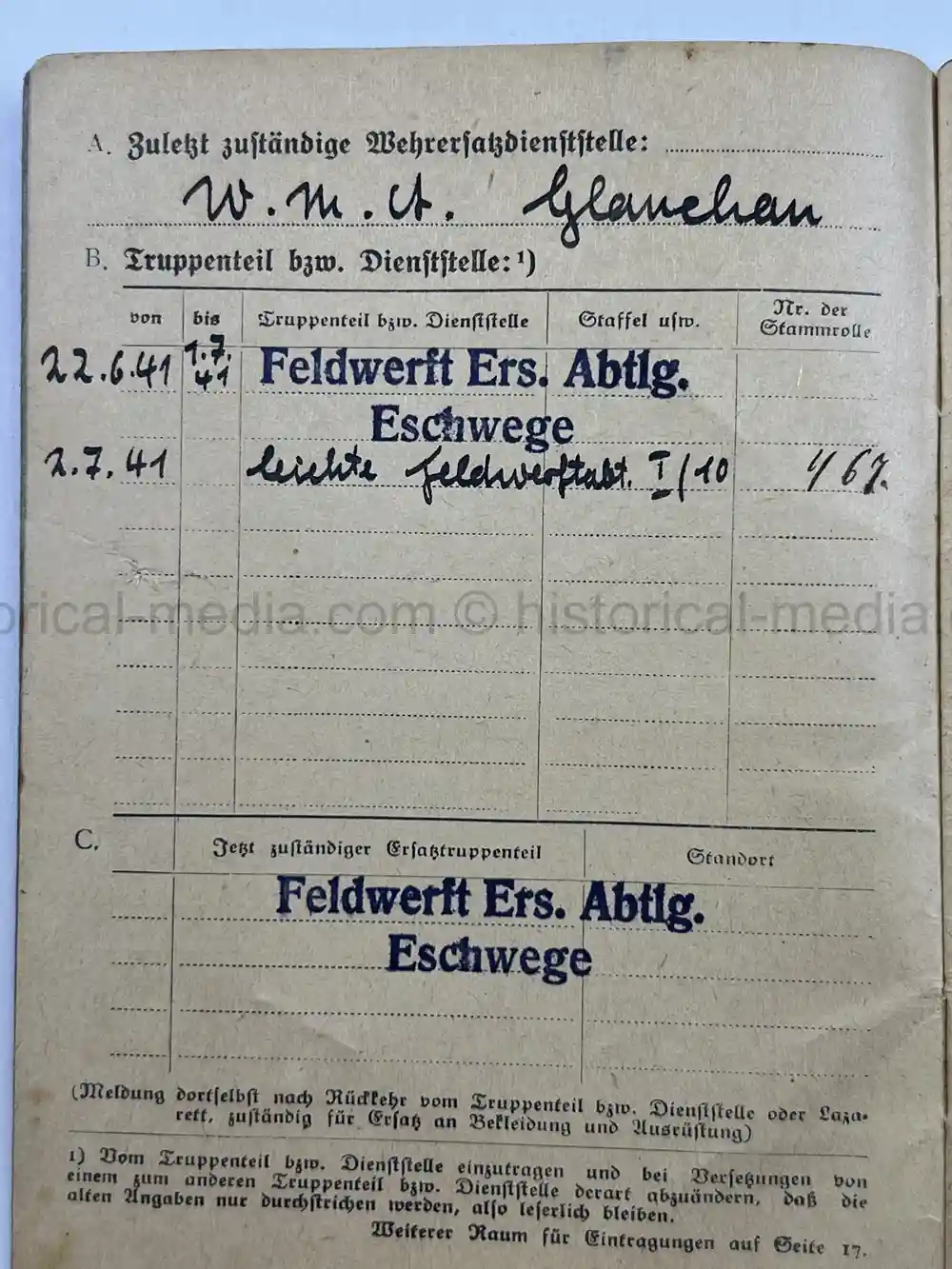
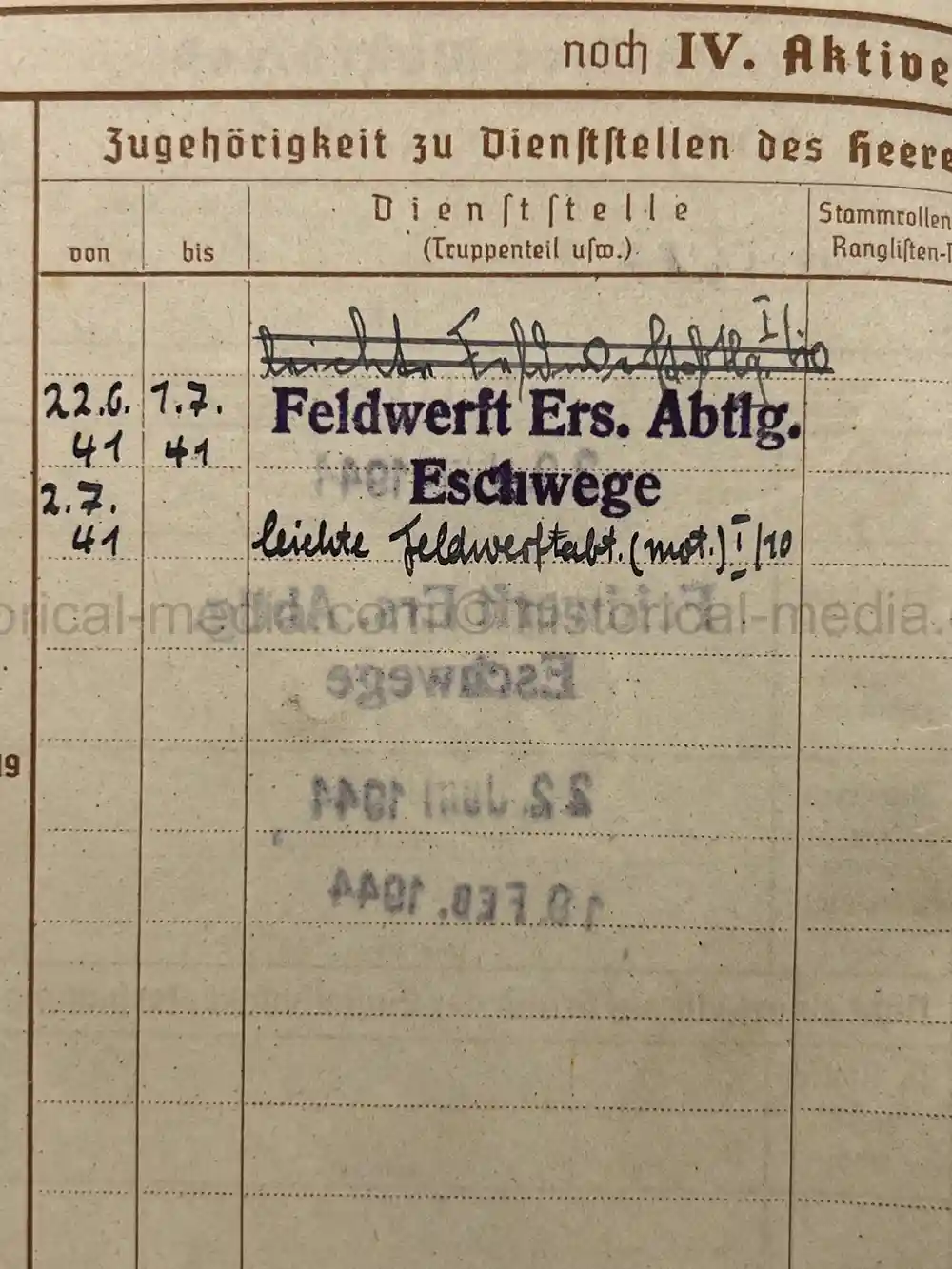
Soldbuch unit page (left) / Wehrpass unit table (right)
The Soldbuch lists Feldwerft-Ersatz-Abteilung Eschwege in the service table and again as the currently responsible replacement unit. It then names leichte Feldwerftabteilung I/40 as the service unit, while Eschwege remains responsible in the replacement section. The Wehrpass records the same sequence in its dated unit table.
What this comparison establishes
Eschwege’s repeated appearance does not create two simultaneous field postings. It illustrates actual earlier service and continuing replacement responsibility. These are Luftwaffe forms: the Soldbuch service record is B and replacement responsibility C, unlike the Heer C/D arrangement. The handwriting of the year figures and a mismatch with the Wehrpass entry-date stamp need owner review before a fully dated timeline is published.
Illustrated document: WEHRPASS – JAGDGESCHWADER 27 – EBEN EMAEL – AFRIKAKORPS – D-DAY – NORMANDY !. Inventory examples may include sold items.
ORIGINAL PAGE 13-15 · Rehermann Wehrpass; Luftwaffe service
Service-unit continuation pages
Source scan needed
This page is included in the book’s page map. A suitable scan is still needed before its printed fields can be translated.
How this page was used
These pages continue the service-unit area in the period outline. The illustrated page 12 explains the date-and-unit structure, but does not establish every printed detail of each continuation page.
Reading notes and open questions
- Complete numbered photographs of pages 13-15 are needed for an exhaustive edition-specific translation.
Illustrated document: WEHRPASS – JAGDGESCHWADER 27 – EBEN EMAEL – AFRIKAKORPS – D-DAY – NORMANDY !. Inventory examples may include sold items.
ORIGINAL PAGE 16-19 · Rehermann Wehrpass; Luftwaffe service
Naval-service tables in the general page outline
Source scan needed
This page is included in the book’s page map. A suitable scan is still needed before its printed fields can be translated.
How this page was used
The period reference outline places naval shore service on pages 16-17 and service afloat or with naval aircraft on pages 18-19. These are retained as a clearly marked source gap rather than populated with Army or Luftwaffe labels.
Reading notes and open questions
- No suitable complete inventory scans of these naval-service forms have been identified. Confirm the exact edition before translating.
Illustrated document: WEHRPASS – JAGDGESCHWADER 27 – EBEN EMAEL – AFRIKAKORPS – D-DAY – NORMANDY !. Inventory examples may include sold items.
ORIGINAL PAGE 20 · Rehermann Wehrpass; Luftwaffe service
Weapon training
Original scan · click to translate
English reading view
Translation of the visible printed fields; personal handwriting and stamps remain in the original scan.
| German printed text | English translation |
|---|---|
| noch IV. Aktiver Wehrdienst | Continuation of IV. Active military service. |
| Ausbildung (auch im Kriege) | Training (also in wartime). |
| 22. Mit der Waffe | 22. With weapons. |
How this page was used
The listed weapons record training. An entry here should not automatically be described as personal possession of that weapon; compare the weapons-possession form in a Soldbuch.
How to read it
“Mit der Waffe” records weapons on which the holder was trained. It does not give the serial number of an issued personal weapon. Compare it with a Soldbuch possession entry only where both documents survive; training with one model and later issue of another are not automatically inconsistent. Preserve abbreviated model designations before expanding them. A list of Waffenausbildung can include rifles, pistols, machine guns, mortars or other weapons. Light and heavy MG designations can refer to the employment of a machine gun; a training entry alone does not establish the soldier’s combat role or ownership of a particular weapon.
The illustrated example
Rehermann’s page includes weapon designations entered beneath the short printed heading. A separate transcription could explain those designations once individually checked.
Illustrated document: WEHRPASS – JAGDGESCHWADER 27 – EBEN EMAEL – AFRIKAKORPS – D-DAY – NORMANDY !. Inventory examples may include sold items.
ORIGINAL PAGE 21 · Rehermann Wehrpass; Luftwaffe service
Other training, courses and badges
Original scan · click to translate
English reading view
Translation of the visible printed fields; personal handwriting and stamps remain in the original scan.
| German printed text | English translation |
|---|---|
| Ausbildung (auch im Kriege) | Training (also in wartime). |
| Sonstige Ausbildung, Lehrgänge | Other training; courses. |
| Abzeichen usw. | Badges, etc. |
How this page was used
The page separates additional training and courses from the badge area. It helps distinguish a course qualification from a decoration entered in the awards section.
How to read it
A Lehrgang is a course, while other entries can concern a qualification or skill. The separate Abzeichen area must be interpreted from the particular entry; the heading does not make every training qualification a combat decoration. Look to pages 22-23 for promotions and awards and to the unit dates to place training in the service sequence.
The illustrated example
The Dalitz example offers a further comparison with driver-related qualifications. These are meaningful entries to explain separately from the form’s headings.
Reading notes and open questions
- The section heading is split across the spread; its complete reading follows the matching left-page heading.
Illustrated document: WEHRPASS – JAGDGESCHWADER 27 – EBEN EMAEL – AFRIKAKORPS – D-DAY – NORMANDY !. Inventory examples may include sold items.
ORIGINAL PAGE 22 · Rehermann Wehrpass; Luftwaffe service
Promotions and appointments
Original scan · click to translate
English reading view
Translation of the visible printed fields; personal handwriting and stamps remain in the original scan.
| German printed text | English translation |
|---|---|
| Beförderungen und Ernennungen *) (auch im Kriege) | Promotions and appointments * (also in wartime). |
| Mit Wirkung vom | With effect from. |
| Befördert oder ernannt zum | Promoted or appointed to. |
How this page was used
The effective date is the key date attached to the promotion or appointment. A signature or certification elsewhere may have a different date.
How to read it
“Mit Wirkung vom” is the effective date. The designation beside it is the new rank or appointment, while the signing officer’s rank belongs to the certification. Abbreviations such as d. R. identify reserve status and should be retained. Continue onto page 23 before concluding that the promotion sequence stops at the bottom of page 22.
The illustrated example
Rehermann’s career can be followed through the successive rank entries into the continuation on page 23.
Reading notes and open questions
- The asterisk refers to the certification instruction on page 23, translated there.
Illustrated document: WEHRPASS – JAGDGESCHWADER 27 – EBEN EMAEL – AFRIKAKORPS – D-DAY – NORMANDY !. Inventory examples may include sold items.
ORIGINAL PAGE 23 · Rehermann Wehrpass; Luftwaffe service
Promotion continuation and decorations
Original scan · click to translate
English reading view
Translation of the visible printed fields; personal handwriting and stamps remain in the original scan.
| German printed text | English translation |
|---|---|
| Beförderungen und Ernennungen *) (auch im Kriege) | Promotions and appointments * (also in wartime). |
| Mit Wirkung vom | With effect from. |
| Befördert oder ernannt zum | Promoted or appointed to. |
| 24. Orden und Ehrenzeichen *) | 24. Orders and decorations. * |
| *) Bescheinigung der Beförderungen, Ernennungen und Verleihungen nach Abschluß der aktiven Dienstzeit durch den Entlassungstruppenteil usw. mit Dienststelle, Unterschrift, Dienstgrad, Dienststellung und Dienststempel. | * Certification of promotions, appointments and awards after completion of active service by the discharging unit, etc., giving the office, signature, rank, appointment and official stamp. |
How this page was used
The upper table continues promotions; the lower area records decorations. The footnote sets out the certification details required after active service.
How to read it
The upper part continues promotions and appointments, while the lower part records Orden und Ehrenzeichen. Read the award’s exact class and any date separately from the administrative certification. The footnote explains how the discharging unit was to certify the record after active service. A later award continuation can also be placed on a Nachträge page.
The illustrated example
Rehermann’s award entries include the Afrika-related distinctions identified in the existing inventory record. Diesing’s award page supplies a further example with several dated awards; the owner’s identifications remain unchanged.
Illustrated document: WEHRPASS – JAGDGESCHWADER 27 – EBEN EMAEL – AFRIKAKORPS – D-DAY – NORMANDY !. Inventory examples may include sold items.
ORIGINAL PAGE 24 · Diesing Wehrpass; earlier Heer form
Discharge from active service
Original scan · click to translate
English reading view
Translation of the visible printed fields; personal handwriting and stamps remain in the original scan.
| German printed text | English translation |
|---|---|
| Entlassung | Discharge. |
| Entlassen am (Tag, Monat, Jahr) | Discharged on (day, month, year). |
| als (Dienstgrad) | As (rank). |
| nach (Wohnsitz) | To (place of residence). |
| von (Truppenteil, Dienststelle) | By (unit, office). |
| Eignung zum (Dienstgrad usw.) | Suitability for (rank, etc.). |
| Stammrollen-Nr. / Ranglisten-Nr. | Personnel-roll number / officer-list number. |
| Art der Entlassung | Form of discharge. |
| Ärztliches Entlassungsurteil | Medical assessment on discharge. |
| Überwiesen an (Wehrbezirkskommando, Wehrmeldeamt) | Referred to (military district recruiting command; military registration office). |
How this page was used
The discharge record states the date, rank, destination, releasing authority and medical assessment. Discharge from this spell of active service does not mean that no later service could follow.
How to read it
This documents the end of a particular spell of active service: when, in what rank, where sent and by which unit. “Eignung zum” is an assessment of suitability, not automatically a promotion already granted. The destination residence and receiving registration office are administrative details after discharge, not a field-unit assignment.
The illustrated example
Diesing’s page records a 1936 discharge as Feldwebel. Later pages record his return to service and promotions, making this a useful example of a career extending beyond one discharge.
Reading notes and open questions
- The printed page number and the running section heading are outside this close-up. Page 24 is identified from the following numbered page 25 and the form sequence.
Illustrated document: WEHRPASS – HAUPTMANN – 31. + 387. INFANTERIE DIVISION – EK1 (8 AWARDS) – KIA 1943. Inventory examples may include sold items.
ORIGINAL PAGE 25 · Diesing Wehrpass; earlier Heer discharge form
Discharge continuation and security instruction
Original scan · click to translate
English reading view
Translation of the visible printed fields; personal handwriting and stamps remain in the original scan.
| German printed text | English translation |
|---|---|
| noch Entlassung | Continuation of discharge. |
| Bevorzugt an Arbeitsplätzen unterzubringen (§ 32 [1] W. G.) | To receive preferential placement in employment (§ 32 [1] of the Military Service Law). |
| Berechtigungsschein für bevorzugte Arbeitsvermittlung vom | Certificate of entitlement to preferential employment placement, dated. |
| Angestelltenschein Nr. / vom | Salaried-employment entitlement certificate no. / dated. |
| Zivildienstschein Nr. / vom | Civil-service entitlement certificate no. / dated. |
| Abschlußprüfung ... bestanden am | Final examination ... passed on. |
| Belehrt über Spionage, Spionageabwehr, Landesverrat, Wahrung des Dienstgeheimnisses und Wehrüberwachung am | Instructed on espionage, counter-espionage, treason, safeguarding official secrets and military supervision on. |
| (Dienststelle) / Dienststempel | (Office) / official stamp. |
| (Unterschrift) / (Dienstgrad, Dienststellung) | (Signature) / (rank, appointment). |
How this page was used
This earlier form combines post-service employment entitlements with certification that the holder received security and supervision instructions. These administrative certificates are not decorations.
How to read it
Employment-entitlement certificates and security instruction have different purposes and share the page for administrative convenience. Date and certificate number belong to the relevant line, not to an award. The printed legal reference concerns preferential employment treatment. Later editions can change the certificate labels or the wording of the security declaration, so the exact version matters.
The illustrated example
The Diesing example shows the unit’s certification at the foot of the page.
Reading notes and open questions
- The specialist English labels for Angestelltenschein and Zivildienstschein are explanatory translations; confirm the preferred terminology before publication.
Illustrated document: WEHRPASS – HAUPTMANN – 31. + 387. INFANTERIE DIVISION – EK1 (8 AWARDS) – KIA 1943. Inventory examples may include sold items.
ORIGINAL PAGE 26-27 · Diesing Wehrpass; supplementary-entry spread
Nachträge - supplementary entries
Original scan · click to translate
English reading view
Translation of the visible printed fields; personal handwriting and stamps remain in the original scan.
| German printed text | English translation |
|---|---|
| noch IV. Aktiver Wehrdienst | Continuation of IV. Active military service. |
| Nachträge | Supplementary entries. |
How this page was used
The ruled space permits additional entries beyond the dedicated tables. What was entered here may duplicate or extend information elsewhere in the book.
How to read it
Nachträge literally supplies additional-entry space. In one book it can hold a later award; in another a reserve appointment or equipment/property handover. The subject must come from the entry itself. Where an annotation says “Fortsetzung” followed by a page number, follow that reference before treating the added text as an unrelated record.
The illustrated example
Diesing’s page 26 records reserve-related changes; the following photographed page 27 continues awards from page 23, including the Infanterie-Sturmabzeichen in Silber and Ostmedaille identified in the inventory record.
Illustrated document: WEHRPASS – HAUPTMANN – 31. + 387. INFANTERIE DIVISION – EK1 (8 AWARDS) – KIA 1943. Inventory examples may include sold items.
ORIGINAL PAGE 28-29 · Walter Miketta Wehrpass; clearly numbered exercise spread, pages 28-29
Reserve training exercises
Original scan · click to translate
English reading view
Translation of the visible printed fields; personal handwriting and stamps remain in the original scan.
| German printed text | English translation |
|---|---|
| Übungen im Beurlaubtenstande | Training exercises while on non-active / reserve status. |
| von / bis | From / to. |
| bei Dienststelle | With office / unit. |
| hat geübt als (Dienstgrad, Verwendung) | Trained as (rank, employment / role). |
| geeignet zum *) | Suitable for. * |
| ärztl. Entlassungsurteil | Medical assessment on discharge. |
| Unterschrift, Dienstgrad, Dienststelle | Signature, rank, office. |
| *) Beförderungen und Ernennungen siehe Seite 37 und 38. | * For promotions and appointments, see pages 37 and 38. |
How this page was used
Read both halves of the spread: dates, unit and role appear on the left; suitability, medical assessment and certification continue on the right. Beurlaubtenstand here is a service status, not an ordinary holiday.
How to read it
These are exercises undertaken while in non-active/reserve status. The left page records period, office and role; the right continues suitability, medical assessment and certification. “hat geübt als” identifies the capacity in which he exercised; “geeignet zum” is an assessment. Neither is automatically identical to a promotion formally entered in the separate reserve-promotion section.
The illustrated example
Miketta’s entries show successive prewar exercises in administrative and pay duties. The role column identifies the capacity in which he trained; the assessments and signatures appear on the facing page.
Illustrated document: WEHRPASS – ZAHLMEISTER – 218. INFANTRY DIVISION – POLAND, FRANCE, RUSSIA, DENMARK – MANY AWARDS. Inventory examples may include sold items.
ORIGINAL PAGE 30-31 · Rehermann Wehrpass; Luftwaffe service
Further reserve-exercise pages
Source scan needed
This page is included in the book’s page map. A suitable scan is still needed before its printed fields can be translated.
How this page was used
The page outline continues the exercise section here. No complete view of these pages is available in the selected galleries.
Reading notes and open questions
- Obtain numbered pages 30-31 before translating any additional instructions or continuation differences.
Illustrated document: WEHRPASS – JAGDGESCHWADER 27 – EBEN EMAEL – AFRIKAKORPS – D-DAY – NORMANDY !. Inventory examples may include sold items.
ORIGINAL PAGE 32-33 · Rehermann Wehrpass; Luftwaffe service
Campaigns, battles and operations
Original scan · click to translate
English reading view
Translation of the visible printed fields; personal handwriting and stamps remain in the original scan.
| German printed text | English translation |
|---|---|
| noch IV. Aktiver Wehrdienst | Continuation of IV. Active military service. |
| Im Kriege mitgemachte Gefechte, Schlachten, Unternehmungen | Engagements, battles and operations participated in during wartime. |
| Tag, Monat, Jahr | Day, month, year. |
| Ortsangabe, Truppenteil usw. | Location, unit, etc. |
How this page was used
The columns link dates with named engagements, operations or locations and units. Continuation leaves and inserted campaign lists need to be read with the bound pages.
How to read it
The printed heading encompasses engagements, battles and operations, so entries can range from a named action to a broad campaign or period of occupation duty. An inserted printed campaign list should be read with the bound entries and its certification. Do not turn a broad formation-level campaign entry into a claim that the individual fought at every place mentioned.
The illustrated example
Rehermann is particularly useful here: the existing inventory record identifies campaigns ranging from Poland and France to Afrika and Normandy. The gallery includes a separate typewritten campaign list as well as these bound pages.
Reading notes and open questions
- Rehermann’s page-33 gallery image contains red annotations already present in the inventory image. A clean source scan would be preferable for the finished guide. No complete entry-by-entry campaign transcription is claimed yet.
Illustrated document: WEHRPASS – JAGDGESCHWADER 27 – EBEN EMAEL – AFRIKAKORPS – D-DAY – NORMANDY !. Inventory examples may include sold items.
ORIGINAL PAGE 34 · Diesing Wehrpass; wound record
Wounds and serious illnesses
Original scan · click to translate
English reading view
Translation of the visible printed fields; personal handwriting and stamps remain in the original scan.
| German printed text | English translation |
|---|---|
| noch IV. Aktiver Wehrdienst | Continuation of IV. Active military service. |
| Im Kriege: Verwundungen und ernstere Krankheiten | In wartime: wounds and serious illnesses. |
| Tag, Monat, Jahr | Day, month, year. |
| Art | Nature / type. |
| Truppenteil, Kriegsschauplatz | Unit, theatre of war. |
How this page was used
This is a record of wounds and serious illness, with date, nature, unit and theatre. It is distinct from a Soldbuch hospital-admission table, whose dates may record admission or transfer rather than the original injury.
How to read it
“Art” asks for the nature of the wound or serious illness, alongside date, unit and theatre. A precise written injury and a broad reporting code carry different levels of detail. Compare the Soldbuch hospital dates where available: admission, transfer and discharge can follow the original wound. Repeated treatment records do not by themselves prove repeated wounding.
The illustrated example
Diesing’s page contains several July 1942 entries. The individual medical terms and place names should be transcribed separately and checked before any expanded narrative is added.
Illustrated document: WEHRPASS – HAUPTMANN – 31. + 387. INFANTERIE DIVISION – EK1 (8 AWARDS) – KIA 1943. Inventory examples may include sold items.
ORIGINAL PAGE 35 · Diesing Wehrpass; supplementary page
Medical and other supplementary entries
Original scan · click to translate
English reading view
Translation of the visible printed fields; personal handwriting and stamps remain in the original scan.
| German printed text | English translation |
|---|---|
| Nachträge | Supplementary entries. |
How this page was used
Nachträge provides supplementary space following the wound and illness record. It could hold later medical examinations, reassessments of fitness and the examining doctor’s certification. Its actual entries can also concern another event: Diesing’s illustrated page records his death. Explain the normal medical use and the particular surviving entry separately.
How to read it
The supplementary space follows the medical section but can carry a distinct later event, such as the death entry in Diesing’s book. Separate the event date from the date of the confirming entry, and preserve the identity of the certifying office. A place-name reading needs direct confirmation from the handwriting or supporting record.
The illustrated example
The Diesing page records that he fell on 3 August 1943, matching the existing owner record. The place-name reading and full certification remain for separate review.
Reading notes and open questions
- Confirm the precise place-name transcription in the death entry before including it. The guide leaves the owner’s existing identification unchanged.
- Examination key: 11 uses historical Harnruhr terminology; interpret from the German entry. 33-34 are grouped in the reference. Preserve edition-specific wording and finger-loss exceptions in 66-67. Do not apply this 80-group key to the Soldbuch hospital illness column.
Diagnosis codes and fitness findings: two different keys
Start with the document field
The Soldbuch hospital illness column and a Wehrpass medical-examination note do not necessarily use the same numbering system. Identify the heading and purpose before looking up a number. The hospital code describes the reporting category for treatment; the separate Fehlertabelle classifies findings considered during a fitness examination.
A practical comparison
In the hospital key, 28 concerns ear disorders. In the separate medical-defect table, 28 concerns colour vision, while 31 concerns deafness and 32 ear disease. A bare number taken from the wrong table can therefore produce an entirely different interpretation. Preserve any letter, Roman numeral or other qualifier attached to the number.
A finding is different from a fitness decision
The number identifies a finding or category; the accompanying decision such as k.v. states the recorded fitness assessment. Neither supplies a complete clinical history. On Wehrpass page 35, Nachträge can include later examinations and reassessments; Diesing’s death entry illustrates another use of the supplementary space.
Read the original wording as well as the number
A written diagnosis, an examination date, the doctor’s certification and the fitness decision each add information. Use them together, and compare a matching Soldbuch where available. Do not infer the exact medical reason for a change of fitness from the abbreviation alone.
Full examination key
The tables below cover numbers 1-80, with 33-34 grouped as in the consulted key, plus the letter qualifiers. They are separate from hospital diagnosis groups 1-36. Concise German lookup labels and English explanations help identify an entry; they do not replace its original wording or constitute a new diagnosis.
Medical-examination findings - complete numbered key
Numbers 1-80; 33-34 share one entry. Key cross-checked against the German classification compilation, including 1937/1941 and 1944 regulations; distinguish historical versions and retain attached qualifiers.
| FEHLERNUMMER / GERMAN LOOKUP LABEL | ENGLISH MEANING |
|---|---|
| 1 - Körperbau / Größe / Gewicht | General physique, height and weight. |
| 2 - Adipositas | Obesity. |
| 3 - Hautleiden | Skin disease; allergies under 48. |
| 4 - Lues | Syphilis. |
| 5 - Tumoren / Knochenwucherung | Tumours and bony outgrowths. |
| 6 - Frakturen | Bone fractures; skull under 19. |
| 7 - Narben | Scars; abdominal scars under 52. |
| 8 - Muskelleiden | Muscle disease; polio after-effects under 17. |
| 9 - Drüsen / Blut | Glandular and blood disorders. |
| 10 - Hämophilie | Haemophilia; the historical term Bluterkrankheit. |
| 11 - Harnruhr | Historical Harnruhr category; exact clinical interpretation requires context. Do not translate automatically as simple incontinence. |
| 12 - Pentosurie / Diabetes | Pentosuria and diabetes mellitus in the German key; not automatically diabetes insipidus. |
| 13 - Gicht | Gout. |
| 14 - Rheumatische Gelenkleiden | Joint rheumatism. |
| 15 - Nervosität / geistige Auffälligkeit | Nervousness and abnormal mental state, in the historical classification. |
| 16 - Epilepsie | Epilepsy. |
| 17 - Poliofolgen / Rückenmark / Lähmung | Residual polio, spinal-cord diseases and paralysis. |
| 18 - Nervenlähmung | Nerve paralysis. |
| 19 - Schädelverletzung / Gehirnerschütterung | Skull fracture, concussion and residual effects. |
| 20 - Lider / Bindehaut | Eyelid and conjunctival diseases. |
| 21 - Trachom | Trachoma. |
| 22 - Tränenapparat | Diseases of tear-producing/drainage organs. |
| 23 - Schielen / optische Medien | Strabismus and disorders of the eye’s refractive structures; neurological cases cross-refer to 18. |
| 24 - Hornhaut | Corneal disease. |
| 25 - Sehvermögen | Visual acuity/function; not internal-organ strength. |
| 26 - Nachtblindheit | Night blindness. |
| 27 - Blindheit / Augenverlust | Blindness and loss of an eye or eyes. |
| 28 - Farbsehstörung | Colour-vision impairment. |
| 29 - Tiefere Augenstrukturen | Disease of the deeper ocular structures. |
| 30 - Ohrmuschel | External-ear deformity. |
| 31 - Schwerhörigkeit | Hearing impairment. |
| 32 - Trommelfell / Mittel- / Innenohr | Eardrum, middle-ear and inner-ear diseases. |
| 33-34 - Nase / Nasennebenhöhlen | Nose and sinus disease. These two numbers are grouped in the consulted key; no unsupported split is assigned. |
| 35 - Mandeln | Tonsillar disease. |
| 36 - Mund / Wangen: Formveränderung | Deformity of mouth and cheeks. |
| 37 - Mundhöhle / Rachen: Fehlbildung | Malformation of oral cavity and pharynx. |
| 38 - Zunge | Enlargement or loss of the tongue. |
| 39 - Zähne / Zahnfleisch / Kiefer | Diseases of teeth, gums and jaws. |
| 40 - Sprache / Taubstummheit | Speech defects and the historical deaf-mutism category. |
| 41 - Schilddrüse | Thyroid disease, including Graves’ disease. |
| 42 - Kehlkopf | Laryngeal disease. |
| 43 - Speiseröhre | Oesophageal disease. |
| 44 - Schiefstellung: Hals / Schulter / Hüfte | Abnormal alignment of neck, shoulder or hip. |
| 45 - Wirbelsäule | Spinal curvature and disease. |
| 46 - Brustkorb: Formveränderung | Chest-wall deformity. |
| 47 - Lungenleiden | All pulmonary diseases. |
| 48 - Allergie | Allergic diseases. |
| 49 - Herzleiden | Cardiac disease. |
| 50 - Becken | Pelvic disease and malformation. |
| 51 - Hernie / Bruchanlage | Hernias, predisposition to hernia and operated hernias with firm scars. |
| 52 - Folgen von Bauchoperationen | After-effects/status following appendectomy or surgery for stomach and bowel disease. |
| 53 - Mastdarm / Hämorrhoiden | Rectal fistula, haemorrhoids and rectal prolapse. |
| 54 - Harnwege / Nieren | Protein in urine, urethral malformation, gonorrhoea, bedwetting and kidney disease. |
| 55 - Varikozele | Dilated veins of the spermatic cord. |
| 56 - Hydrozele | Hydrocele. |
| 57 - Hodenlage / -entwicklung | Displaced or underdeveloped testes. |
| 58 - Hodenleiden / -verlust | Disease or loss of a testis. |
| 59 - Armknochen / -muskulatur | Bone or muscle disease of the arm. |
| 60 - Armverlust | Total or partial loss of an arm. |
| 61 - Beinverlust | Total or partial loss of a leg. |
| 62 - Gelenkverletzung | Joint injury. |
| 63 - Frische Armfraktur | Recent fracture of an arm. |
| 64 - Schlüsselbein: Formveränderung | Clavicular deformity. |
| 65 - Verwachsene Finger | Fused/webbed fingers. |
| 66 - Verlust von Fingergliedern | Loss of finger segments; specified exceptions concern the thumb and right index finger. |
| 67 - Fingerverlust | Loss of a finger; exceptions concern the thumb and index finger. Preserve the original qualification. |
| 68 - Zeigefingerverlust | Loss of an index finger. |
| 69 - Endglied / Fingergelenke | Deformity of the distal finger segment and restricted finger-joint movement. |
| 70 - Fingerkrümmung / -steife | Curved or stiff fingers. |
| 71 - Überzählige Finger | Additional fingers. |
| 72 - O- / X-Beine / Beinverkürzung | Bow legs, knock knees and shortening of a leg. |
| 73 - Varizen | Varicose veins. |
| 74 - Unterschenkelulzera | Lower-leg ulcers. |
| 75 - Fußform | Altered shape of the feet. |
| 76 - Zehenstellung | Curved or abnormally positioned toes. |
| 77 - Zehensteife / -verwachsung / -verlust | Stiffness, fusion or loss of toes. |
| 78 - Überzählige Zehen | Additional toes. |
| 79 - Erbleiden | Hereditary diseases, in the historical classification. |
| 80 - Tropenkrankheiten | Tropical diseases. |
Medical-examination codes - letter qualifiers
A letter qualifies the finding’s effect on fitness; the number identifies the finding. These are not interchangeable with k.v., g.v.F. and g.v.H. fitness decisions. Read the full entry and date.
| LETTER / GERMAN SUMMARY | ENGLISH MEANING |
|---|---|
| A - Tauglichkeit nicht beeinträchtigt | Finding does not impair fitness. |
| B - Bedingte Tauglichkeit | Finding still permits conditional fitness. |
| Z - Zeitlich untauglich | Temporarily unfit. |
| L - Beschränkte Verwendung | Restricted service use, without substantial loss of working capacity. |
| U - Arbeitsleistung möglich | Generally unsuitable for armed service, but able to undertake useful regular work. |
| VU - Keine geregelte Verwendung | No useful regular service employment considered possible. |
Independent German classification cross-check, appendix 10.4
Illustrated document: WEHRPASS – HAUPTMANN – 31. + 387. INFANTERIE DIVISION – EK1 (8 AWARDS) – KIA 1943. Inventory examples may include sold items.
ORIGINAL PAGE 36 · Walter Adam Wehrpass; complete reserve-category form, page 36
Transfer into reserve categories
Original scan · click to translate
English reading view
Translation of the visible printed fields; personal handwriting and stamps remain in the original scan.
| German printed text | English translation |
|---|---|
| V. Wehrdienst im Beurlaubtenstande | V. Military service in non-active / reserve status. |
| Übergeführt in die Reserve ... (I oder II) | Transferred to Reserve ... (I or II). |
| am (Tag, Monat, Jahr) | On (day, month, year). |
| von (Wehrbezirkskommando, Wehrmeldeamt) | By (military district recruiting command; military registration office). |
| Dienststempel | Official stamp. |
| Übergeführt in die Landwehr ... (I oder II) | Transferred to Landwehr ... (I or II). |
| Übergeführt in den Landsturm ... (I oder II) | Transferred to Landsturm ... (I or II). |
| (nur unter den Voraussetzungen des § 6 des Wehrgesetzes) | (Only under the conditions specified in § 6 of the Military Service Law.) |
| am / von / Dienststempel | Date / responsible office / official stamp. These fields repeat in the Landwehr and Landsturm blocks. |
How this page was used
The printed blocks distinguish Reserve, Landwehr and Landsturm categories. The dated transfer and responsible office establish the recorded status; these headings should not be treated as field-unit names.
How to read it
Reserve, Landwehr and Landsturm are different status categories, each with a date and responsible recruiting/registration authority. The categories do not name front-line formations. Read the dated transfer with the discharge on pages 24-25 and any later exercise or recall record. An unused later category does not mean that the printed category was inapplicable to all holders.
The illustrated example
Adam’s page records transfer to Reserve I after discharge from active service. The unused Landwehr and Landsturm blocks remain fully visible, making the differences between the three printed categories easier to explain.
Illustrated document: WEHRPASS – WALTER ADAM – 60. + 8. INFANTERIE DIVISION – POLENFELDZUG – WESTFELDZUG – VOLKSSTURM 1944. Inventory examples may include sold items.
ORIGINAL PAGE 37-38 · Walter Miketta Wehrpass; reserve promotions, pages 37-38
Reserve promotions and appointments
Original scan · click to translate
English reading view
Translation of the visible printed fields; personal handwriting and stamps remain in the original scan.
| German printed text | English translation |
|---|---|
| noch V. Wehrdienst im Beurlaubtenstande | Continuation of V. Military service in non-active / reserve status. |
| Beförderungen und Ernennungen *) | Promotions and appointments. * |
| Mit Wirkung vom | With effect from. |
| Befördert oder ernannt zum | Promoted or appointed to. |
| Orden und Ehrenzeichen *) | Orders and decorations. * |
| *) Bestätigung der Beförderungen, Ernennungen und Verleihungen nach Abschluß von Übungen durch den Entlassungstruppenteil usw. mit Dienststelle, Unterschrift, Dienstgrad, Dienststellung und Dienststempel. | * Certification of promotions, appointments and awards after completion of exercises by the discharging unit, etc., giving the office, signature, rank, appointment and official stamp. |
How this page was used
The reserve-status section has its own promotion and appointment table. Read it with the earlier active-service promotion pages to follow the whole sequence.
How to read it
This is the promotion and appointment record for reserve-status service, distinct from the active-service table. Its effective-date column and certification help locate changes between exercises and later service periods. The footer specifically refers to certification after exercises. The abbreviations attached to a rank or appointment should remain visible in any translation.
The illustrated example
Miketta’s left page is visibly numbered 37 and records reserve appointments. The facing page continues the promotion table and provides the award area. The footnote concerns completion of exercises, a distinct wording from the active-service instruction on page 23.
Illustrated document: WEHRPASS – ZAHLMEISTER – 218. INFANTRY DIVISION – POLAND, FRANCE, RUSSIA, DENMARK – MANY AWARDS. Inventory examples may include sold items.
ORIGINAL PAGE 39-40 · Rehermann Wehrpass; Luftwaffe service
Remaining reserve-status pages
Source scan needed
This page is included in the book’s page map. A suitable scan is still needed before its printed fields can be translated.
How this page was used
These pages fall within the reserve-status section in the period outline. Their edition-specific fields remain to be checked against complete inventory scans.
Reading notes and open questions
- Need numbered pages 39-40; the photographed promotion page in Diesing is 38 and must not be used to stand in for these pages.
Illustrated document: WEHRPASS – JAGDGESCHWADER 27 – EBEN EMAEL – AFRIKAKORPS – D-DAY – NORMANDY !. Inventory examples may include sold items.
ORIGINAL PAGE 41 · Rehermann Wehrpass; Luftwaffe service
Residence registrations and deregistrations
Original scan · click to translate
English reading view
Translation of the visible printed fields; personal handwriting and stamps remain in the original scan.
| German printed text | English translation |
|---|---|
| Anmeldungen / Abmeldungen | Registrations / deregistrations. |
| nach | To [destination]. |
| Tag, Monat, Jahr | Day, month, year. |
| Dienststempel | Official stamp. |
How this page was used
The repeated blocks track registration and deregistration, with dates and official stamps. These are residence or reporting records in the reserve-status section, rather than a substitute for the field-unit service table.
How to read it
Anmeldung and Abmeldung record reporting or registration and departure/deregistration. A destination after nach belongs to that transaction. The stamps can establish where the holder was registered at a particular date, but do not by themselves identify a field-service unit. Compare the reporting record with discharge, recall and service dates before building a movement timeline.
The illustrated example
Rehermann’s page shows several dated registration stamps. Its visible printed page number is 41.
Reading notes and open questions
- The running heading is only partly visible. Translate the complete spread heading once an uncropped view is available.
Illustrated document: WEHRPASS – JAGDGESCHWADER 27 – EBEN EMAEL – AFRIKAKORPS – D-DAY – NORMANDY !. Inventory examples may include sold items.
ORIGINAL PAGE 42-45 · Rehermann Wehrpass; Luftwaffe service
Residence-registration continuations
Source scan needed
This page is included in the book’s page map. A suitable scan is still needed before its printed fields can be translated.
How this page was used
Further registration pages are retained in the coverage map. The printed page-41 pattern is not enough to certify every line on all four continuation pages.
Reading notes and open questions
- Complete scans of pages 42-45 are needed for exhaustive translation.
Illustrated document: WEHRPASS – JAGDGESCHWADER 27 – EBEN EMAEL – AFRIKAKORPS – D-DAY – NORMANDY !. Inventory examples may include sold items.
ORIGINAL PAGE 46 · Walter Adam Wehrpass; equipment-size and supplementary-entry form
Equipment sizes and supplementary entries
Original scan · click to translate
English reading view
Translation of the visible printed fields; personal handwriting and stamps remain in the original scan.
| German printed text | English translation |
|---|---|
| Größennummern | Size numbers. |
| Gasmaske | Gas mask. |
| Stahlhelm | Steel helmet. |
| Mütze | Cap. |
| Stiefel | Boots. |
| Nachträge | Supplementary entries. |
How this page was used
The size fields provide practical issue information for personal equipment. The supplementary area below can hold further administrative entries; its use should be interpreted from the actual entry, not from the equipment headings above.
How to read it
These are issue sizes, not physical ranks or medical diagnoses. Gas-mask, helmet, cap and boot sizes each belong to their own field and may use different numbering. The Nachträge space can carry unrelated administrative information, as Adam’s added discharge-money entry demonstrates. Preserve the separation between the printed size form and the written financial addition.
The illustrated example
Adam’s form includes a boot-size entry and an added record of Entlassungsgeld (discharge money). This clear version illustrates equipment sizes, but has no visible preprinted blood-group field. A blood-group label from another edition is not added to its translation.
Reading notes and open questions
- The page number is outside the photograph. This is the equipment-size section in the page-46 position; a numbered wider view would settle the precise edition mapping.
Illustrated document: WEHRPASS – WALTER ADAM – 60. + 8. INFANTERIE DIVISION – POLENFELDZUG – WESTFELDZUG – VOLKSSTURM 1944. Inventory examples may include sold items.
ORIGINAL PAGE 47 · Rehermann Wehrpass; Luftwaffe service
Additional campaign entries on a blank ruled page
Original scan · click to translate
English reading view
Legible entered record. Unclear entries remain marked.
This page has no translated printed fields. Read the example notes below alongside the original scan.
How this page was used
The illustrated page is numbered 47 and has a printed frame but no visible preprinted subject heading. The campaign-continuation heading and entries are additions, not text from the blank form.
How to read it
The page provides additional space beyond the principal subject tables. Rehermann’s campaign continuation should be read with pages 32-33 and the separate inserted list, not as a new printed campaign section. The handwritten heading and certification establish how this particular blank framed page was used.
The illustrated example
Rehermann’s added campaign entries demonstrate how information continued beyond the main campaign table. They should be linked to pages 32-33 and the inserted campaign list.
Reading notes and open questions
- A separate full transcription of the handwritten campaign continuation remains for review.
Illustrated document: WEHRPASS – JAGDGESCHWADER 27 – EBEN EMAEL – AFRIKAKORPS – D-DAY – NORMANDY !. Inventory examples may include sold items.
ORIGINAL PAGE 48-51 · Rehermann Wehrpass; Luftwaffe service
Further pages for additional entries
Source scan needed
This page is included in the book’s page map. A suitable scan is still needed before its printed fields can be translated.
How this page was used
The period page outline places further additional-entry space here. These pages are mapped without assuming that every edition has an identical blank layout.
Reading notes and open questions
- Complete source views needed to establish whether these particular pages contain printed wording or only ruled space.
Illustrated document: WEHRPASS – JAGDGESCHWADER 27 – EBEN EMAEL – AFRIKAKORPS – D-DAY – NORMANDY !. Inventory examples may include sold items.
ORIGINAL PAGE 52 · Rehermann Wehrpass; Luftwaffe service
Safeguarding instructions
Source scan needed
This page is included in the book’s page map. A suitable scan is still needed before its printed fields can be translated.
How this page was used
The printed contents list identifies Bestimmungen (instructions) on page 52. The complete German instruction text is not visible in the selected galleries.
Reading notes and open questions
- A complete final-page scan is required for translation of the instructions. Do not substitute a modern summary for the original wording.
Illustrated document: WEHRPASS – JAGDGESCHWADER 27 – EBEN EMAEL – AFRIKAKORPS – D-DAY – NORMANDY !. Inventory examples may include sold items.
Guide text, translations and presentation © 2026 Historical Media, Inc. All rights reserved.