
Description
WEHRPASS & DEATH NOTIFICATION LETTER – 122. INFANTERIE-DIVISION – POLAND, FRANCE, LENINGRAD & DEMJANSK – TWICE WOUNDED – KIA 8.12.1943 NEWEL – POSTHUMOUS EKII
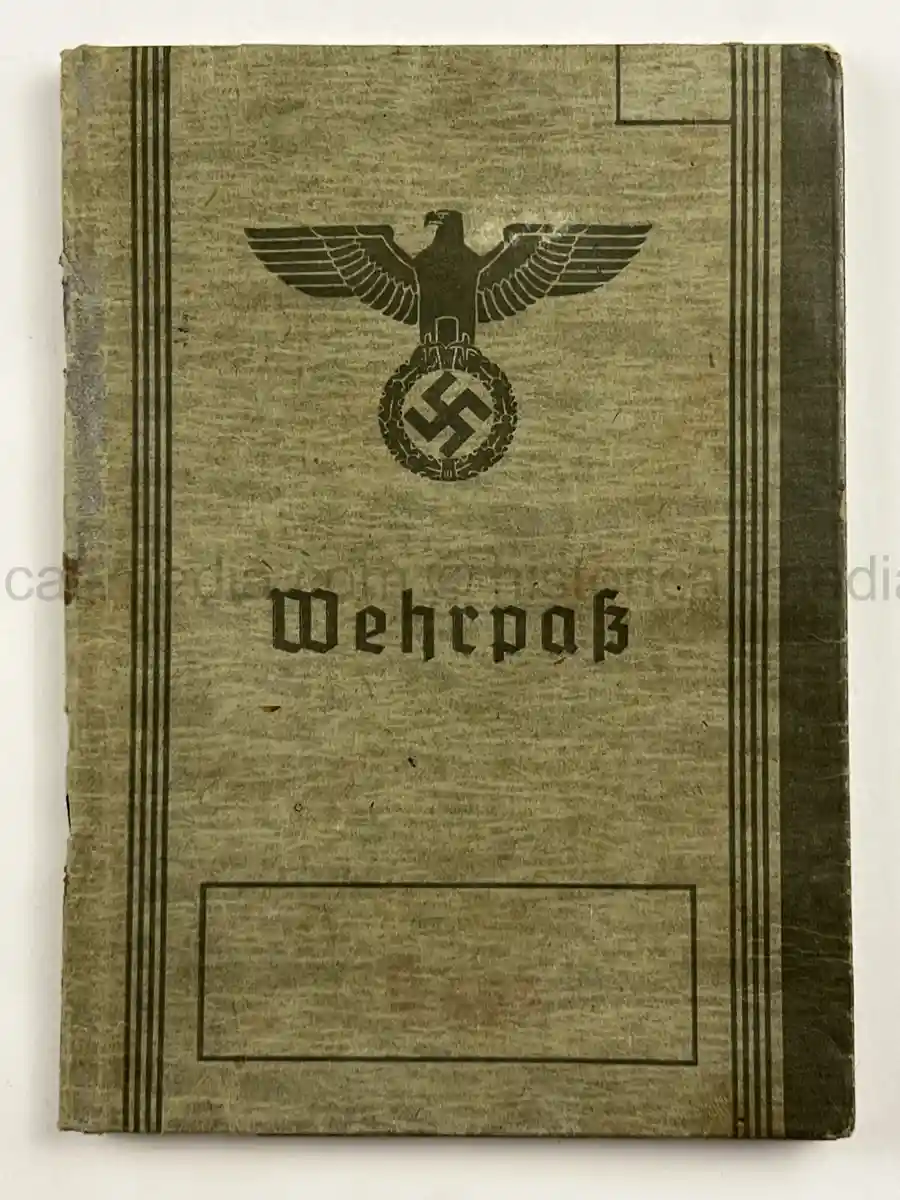
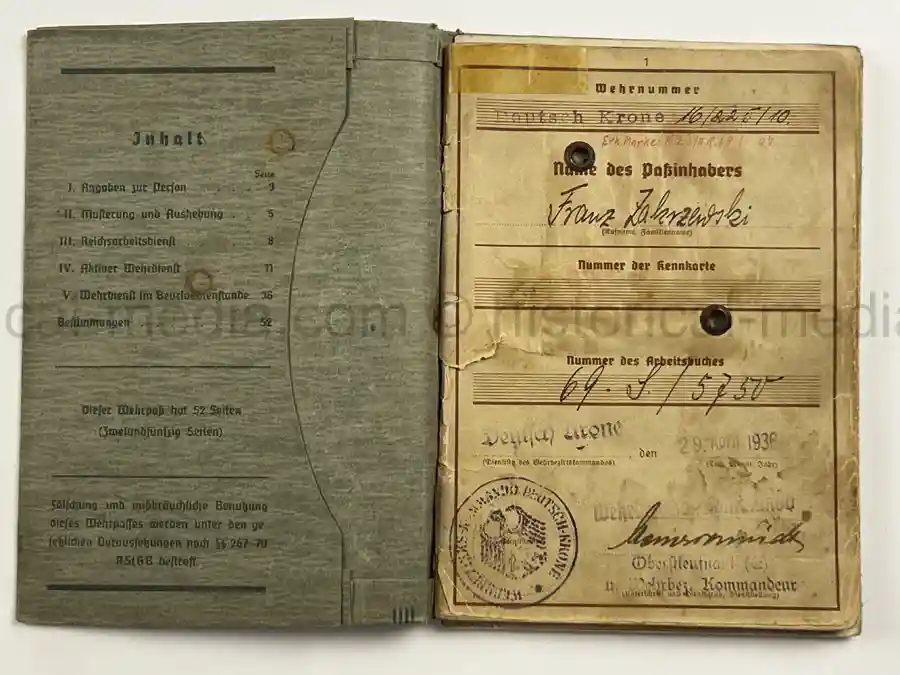
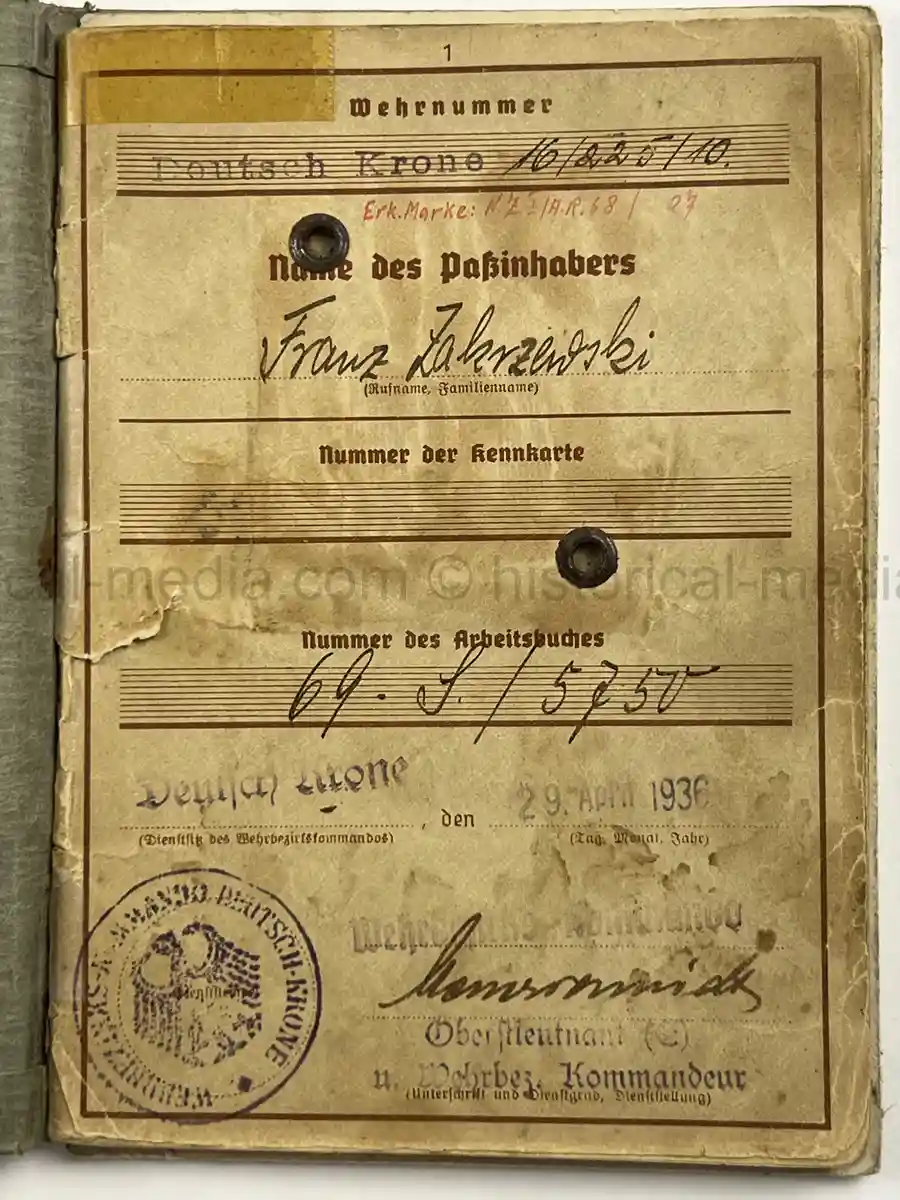
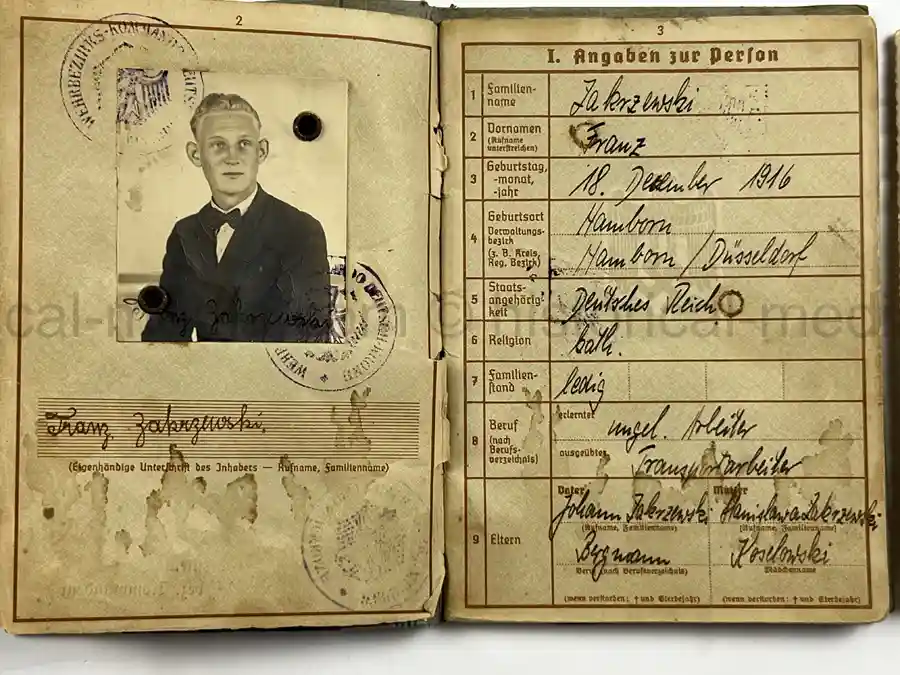
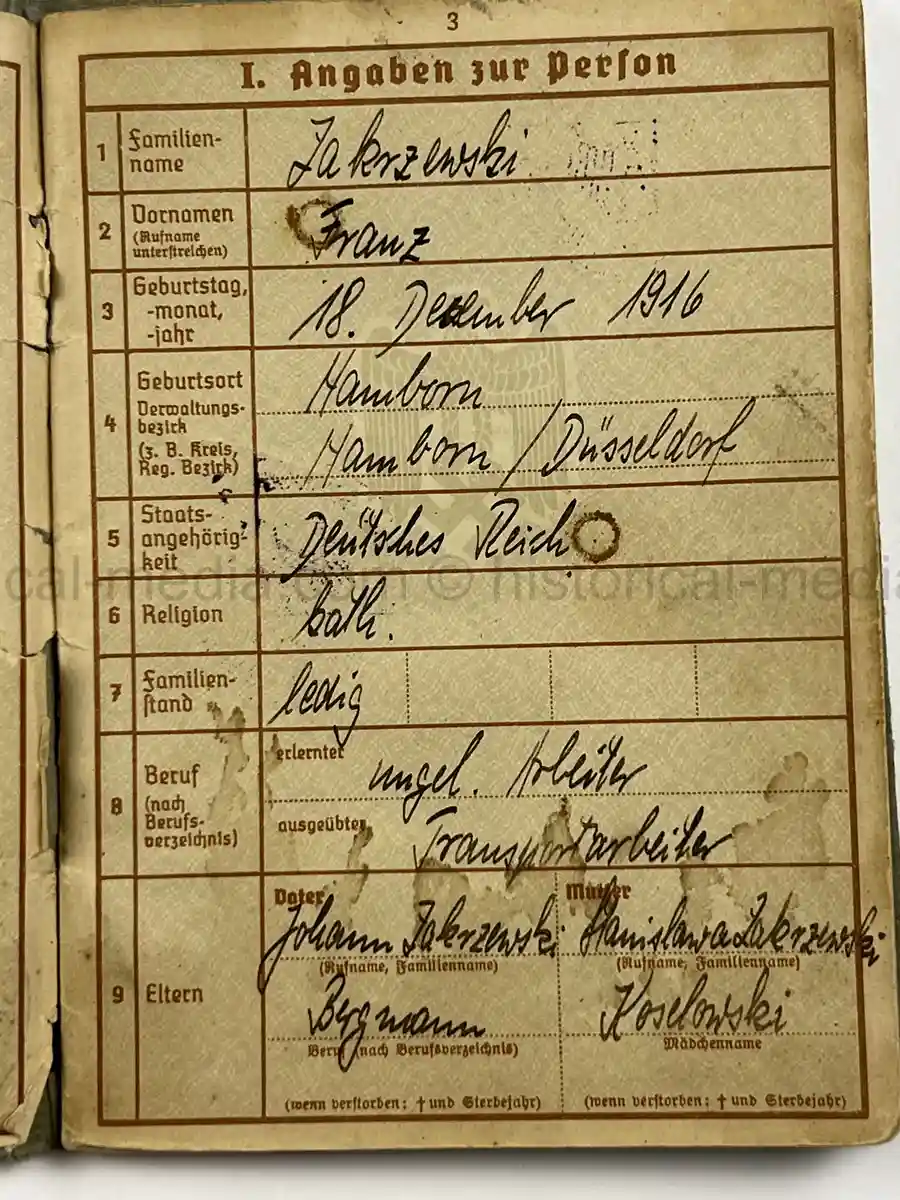
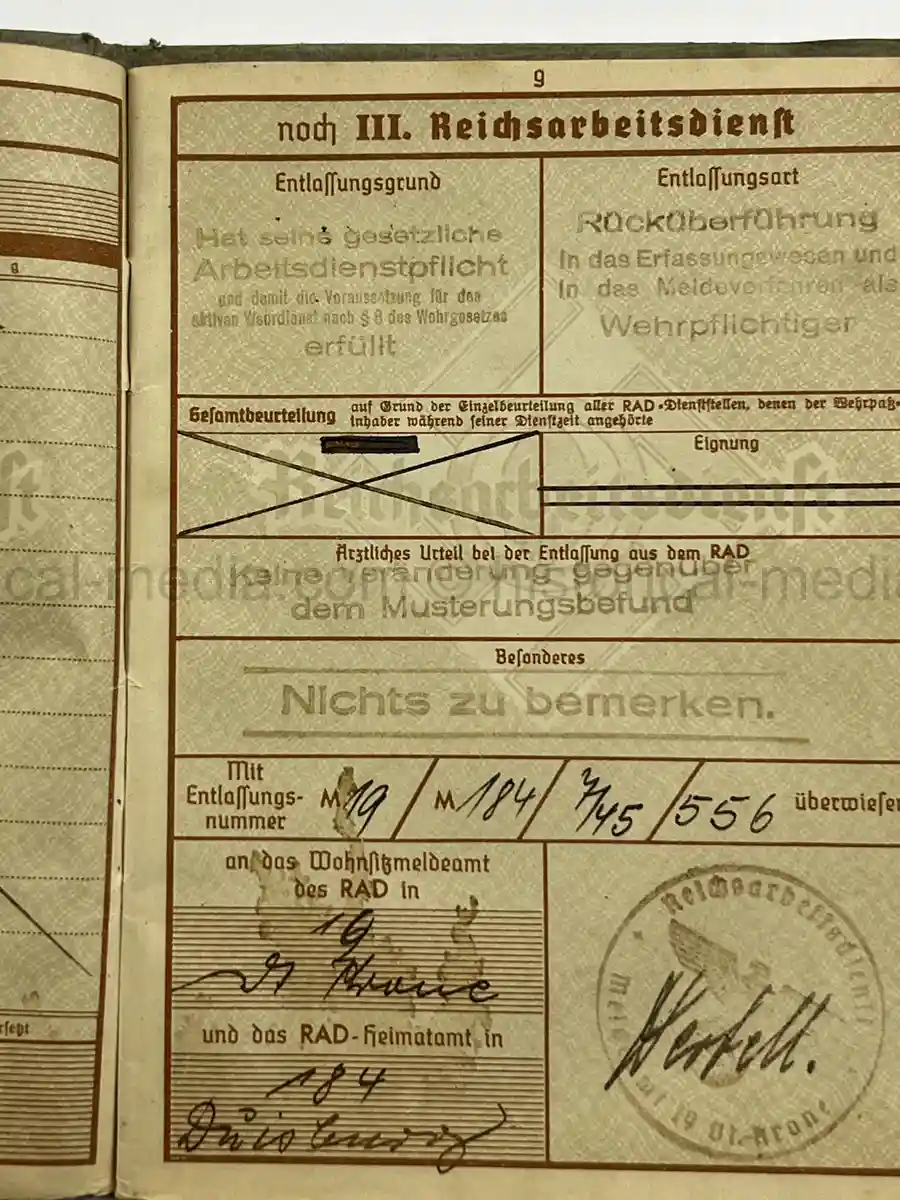
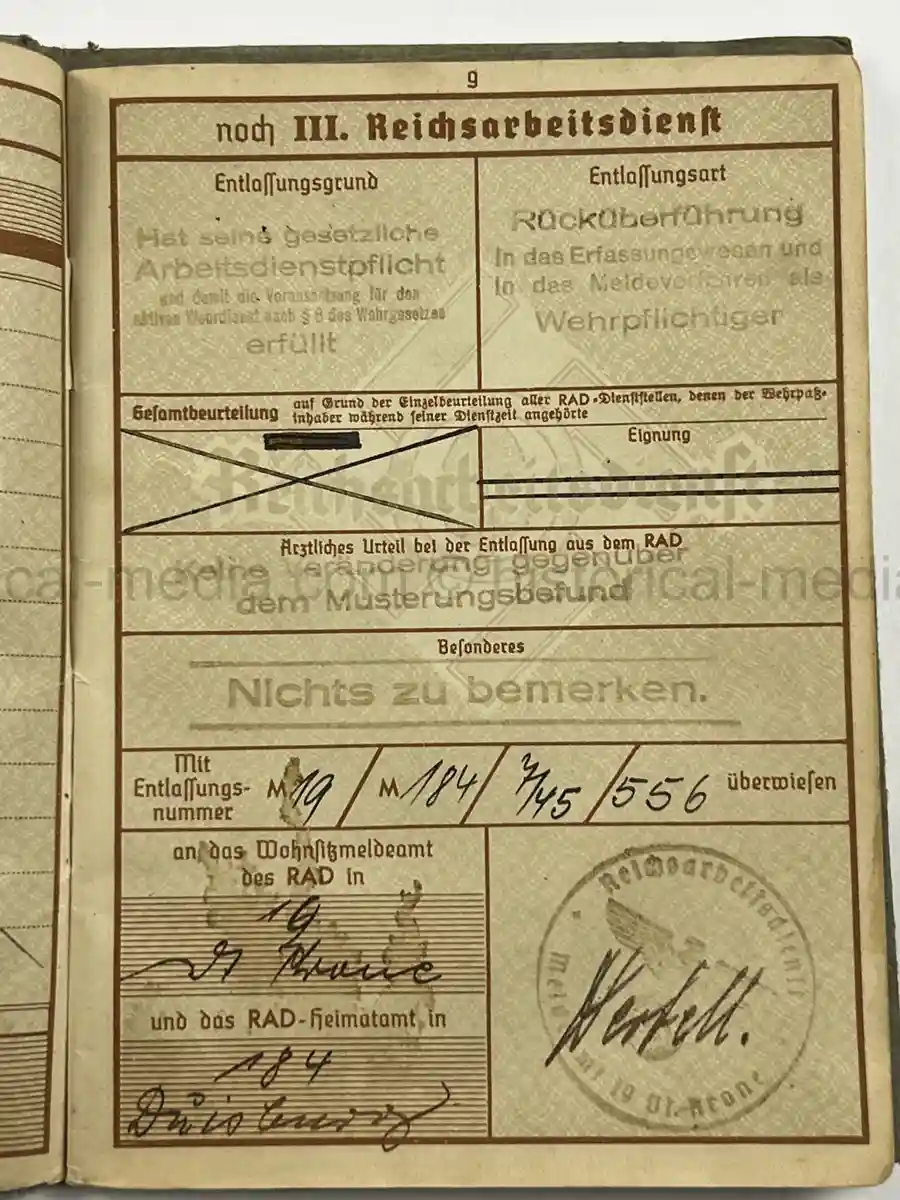
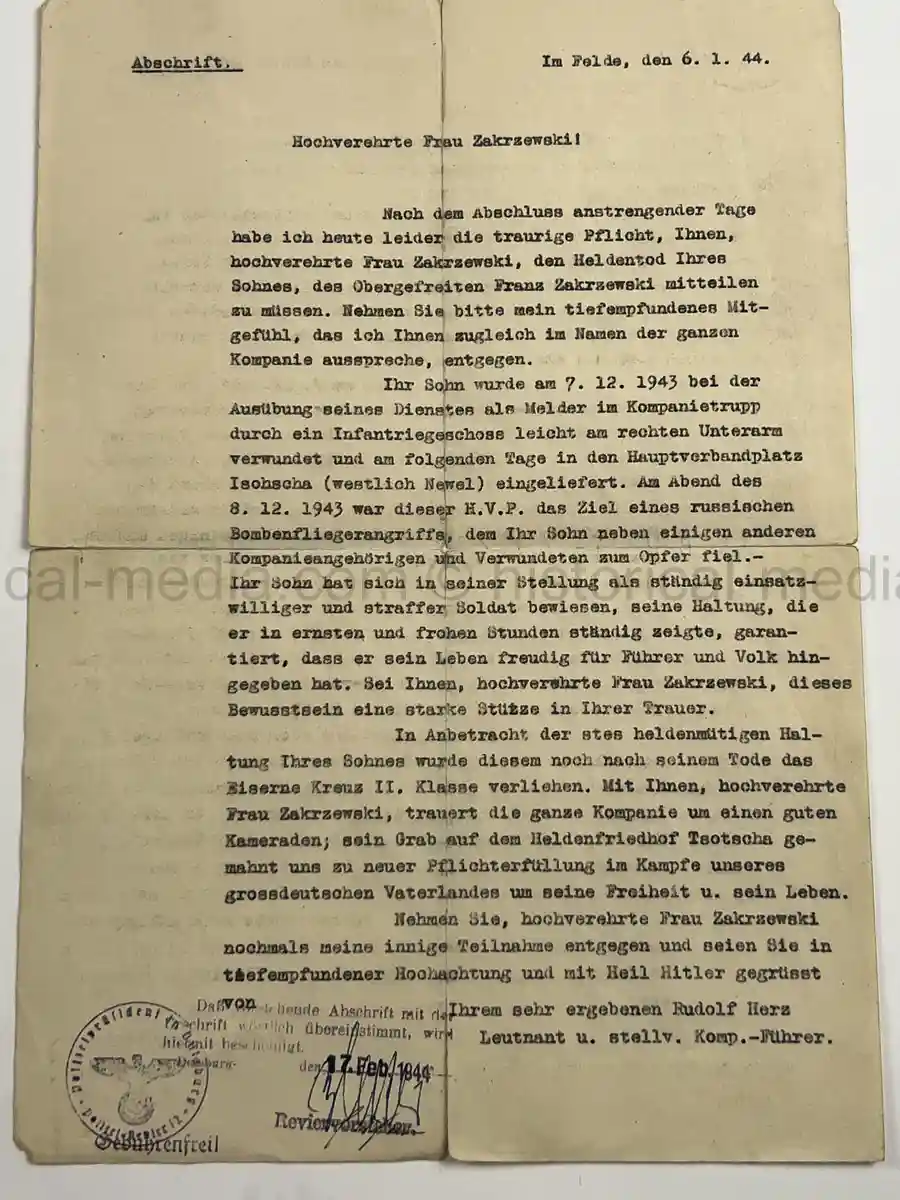
Extensively documented Heer Wehrpass issued to Obergefreiter Franz ZAKRZEWSKI, born December 18, 1916, in Hamborn, near Duisburg. A transport worker by civilian profession, Zakrzewski entered active military service in November 1938 and participated in the Polish and Western Campaigns before serving extensively on the northern sector of the Eastern Front with the 122. Infanterie-Division. Particularly noteworthy are his detailed original printed campaign inserts covering the offensive against LENINGRAD and the relief of the DEMJANSK pocket, two documented combat wounds, a posthumous award of the Iron Cross 2nd Class and an original wartime certified copy of the condolence letter sent to his mother describing the circumstances of his death.
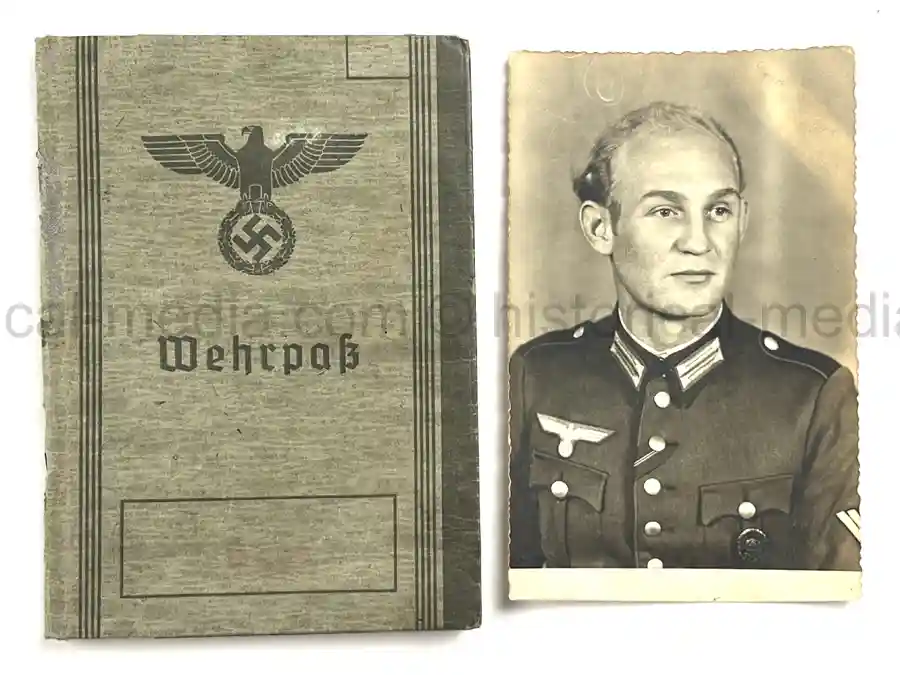
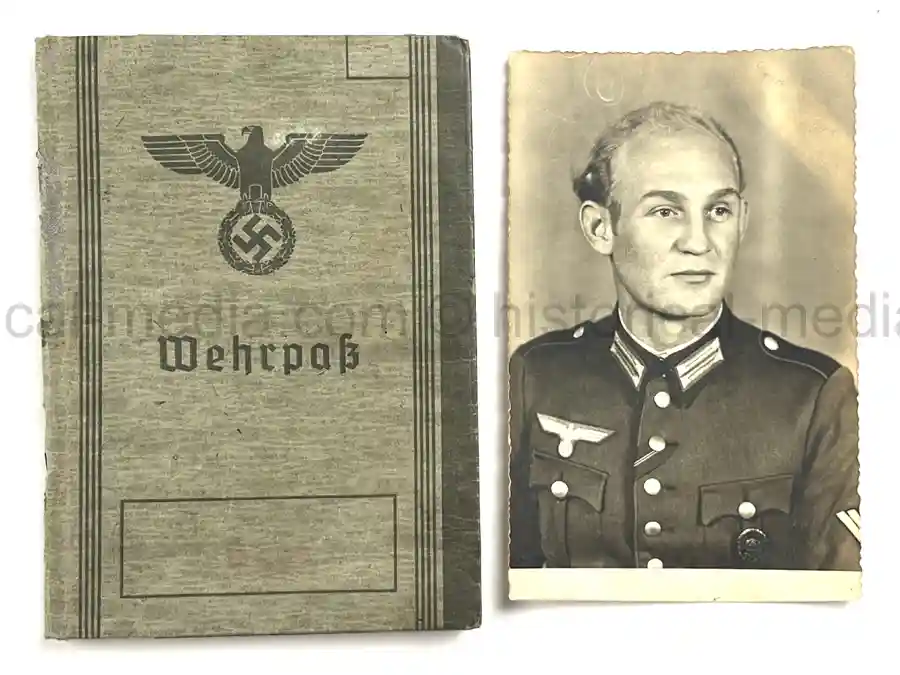
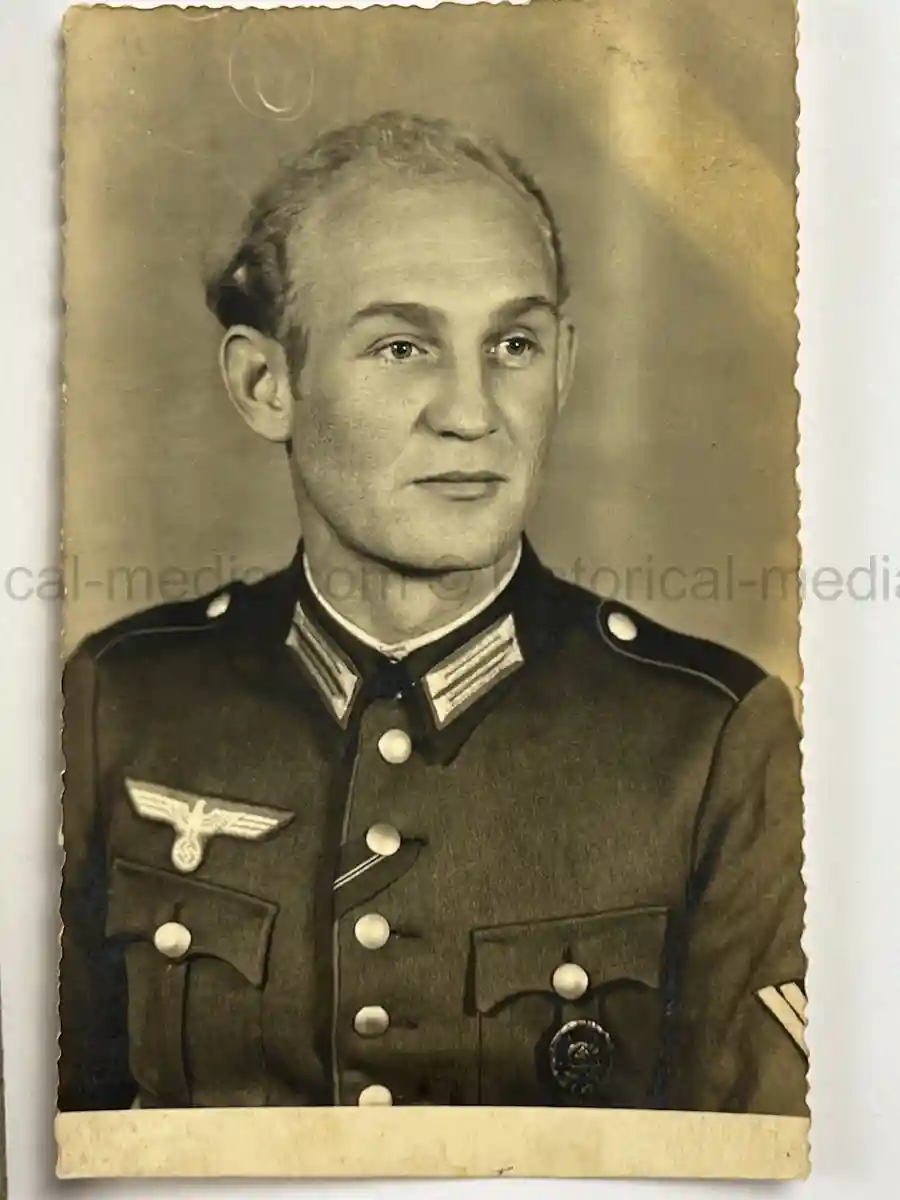
Also included is an excellent separate uniform portrait photograph showing him wearing his Black Wound Badge and Eastern Front Medal ribbon.
PREWAR MILITARY SERVICE & UNIT ASSIGNMENTS
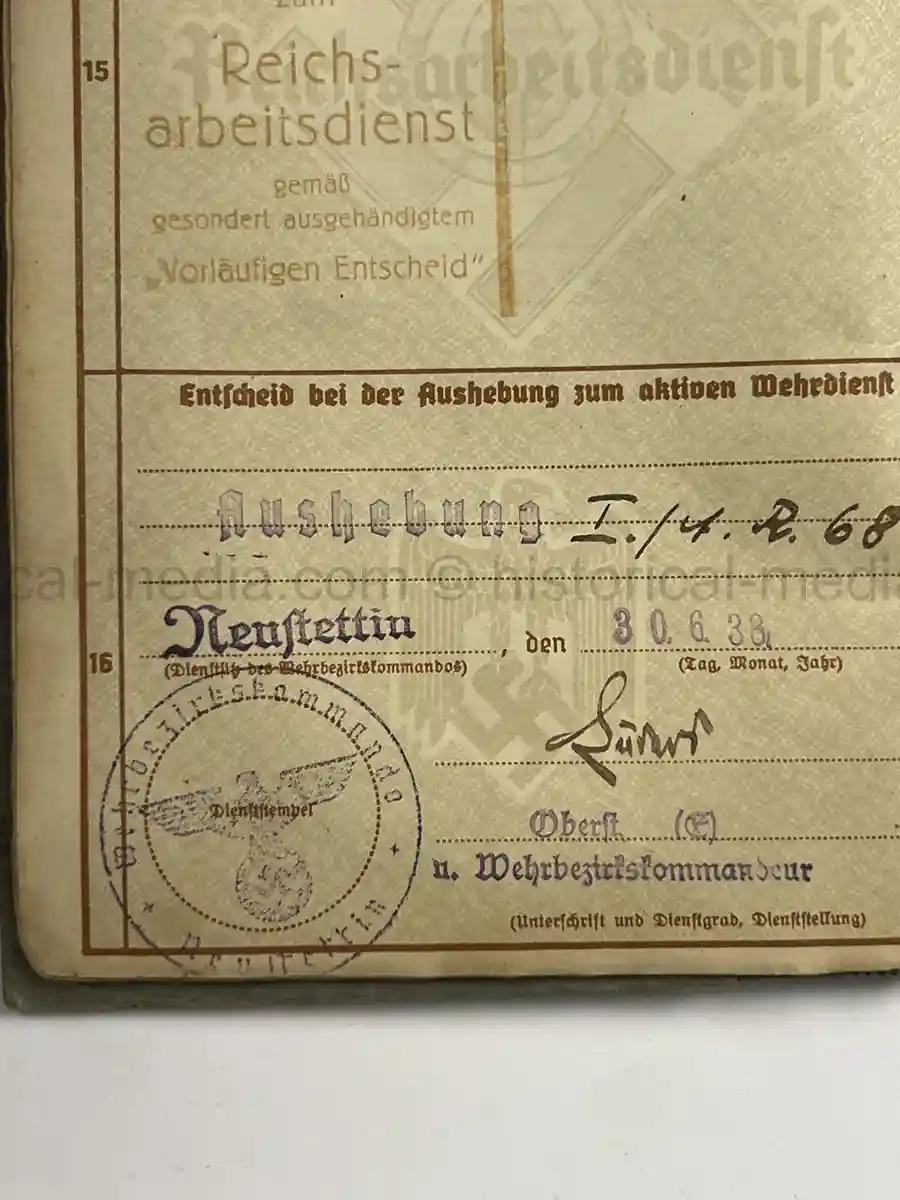
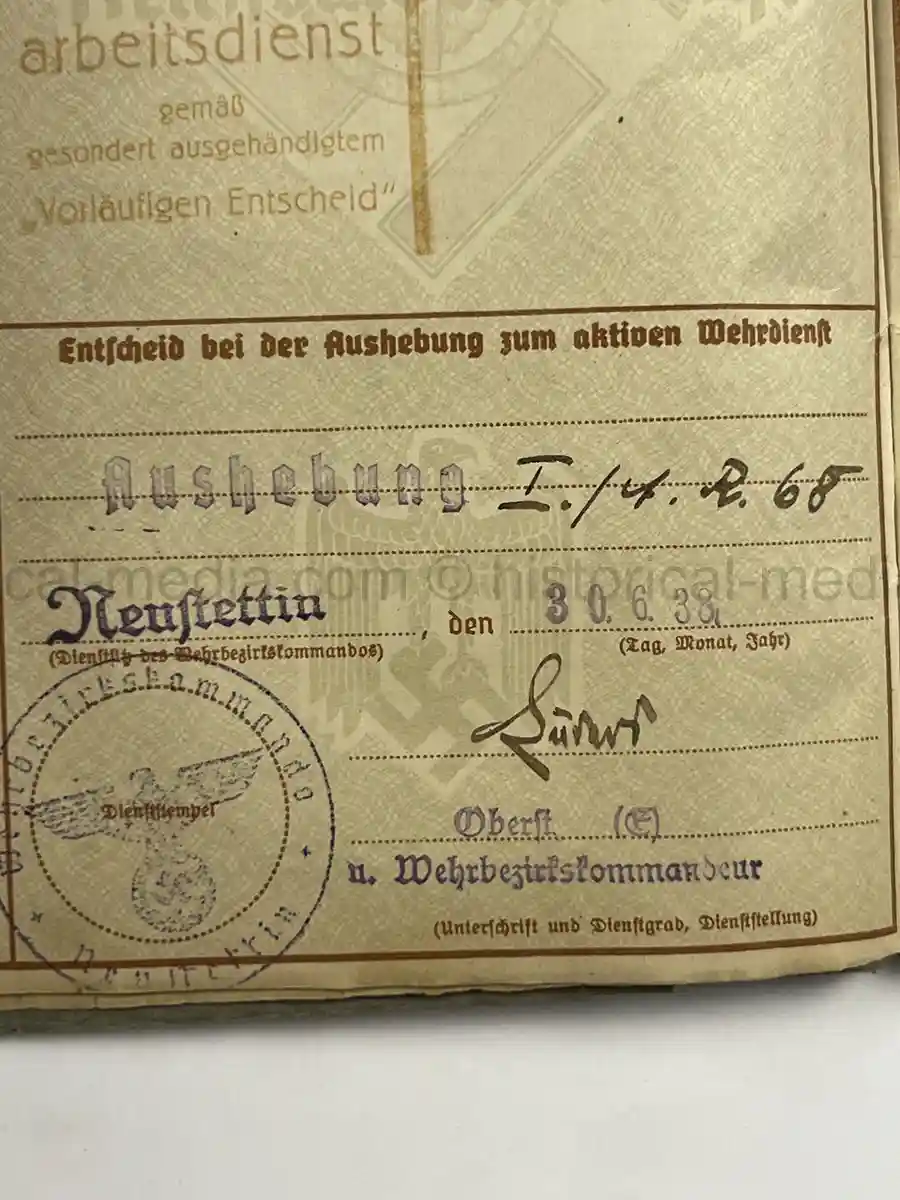
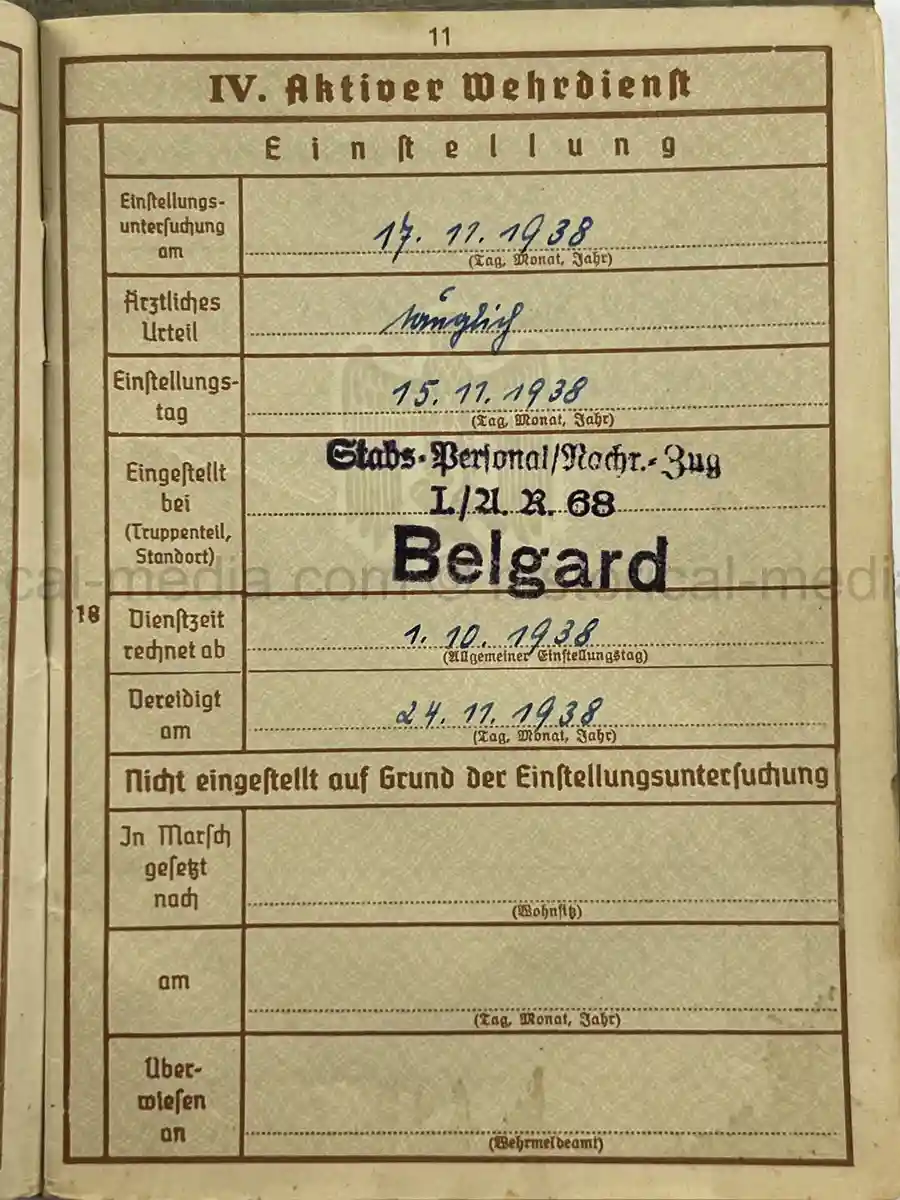
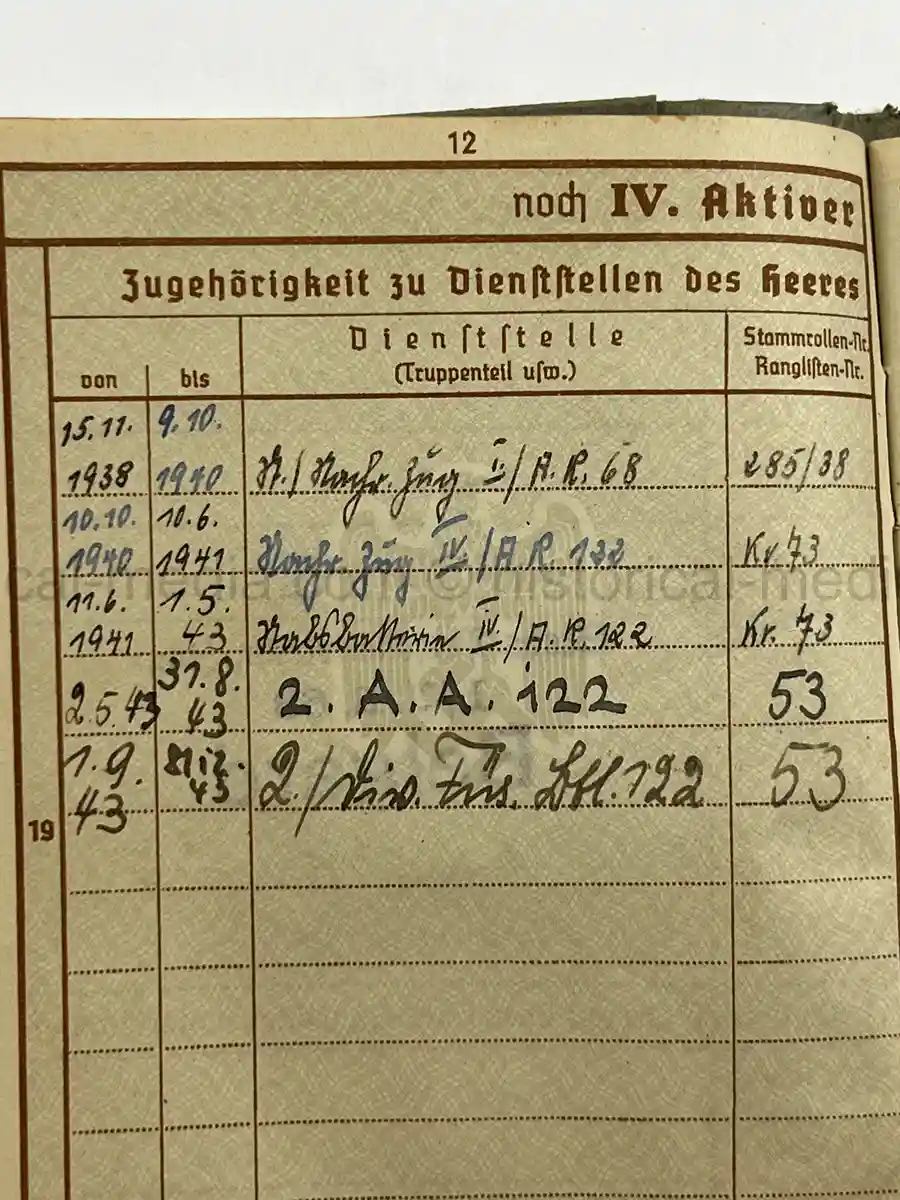
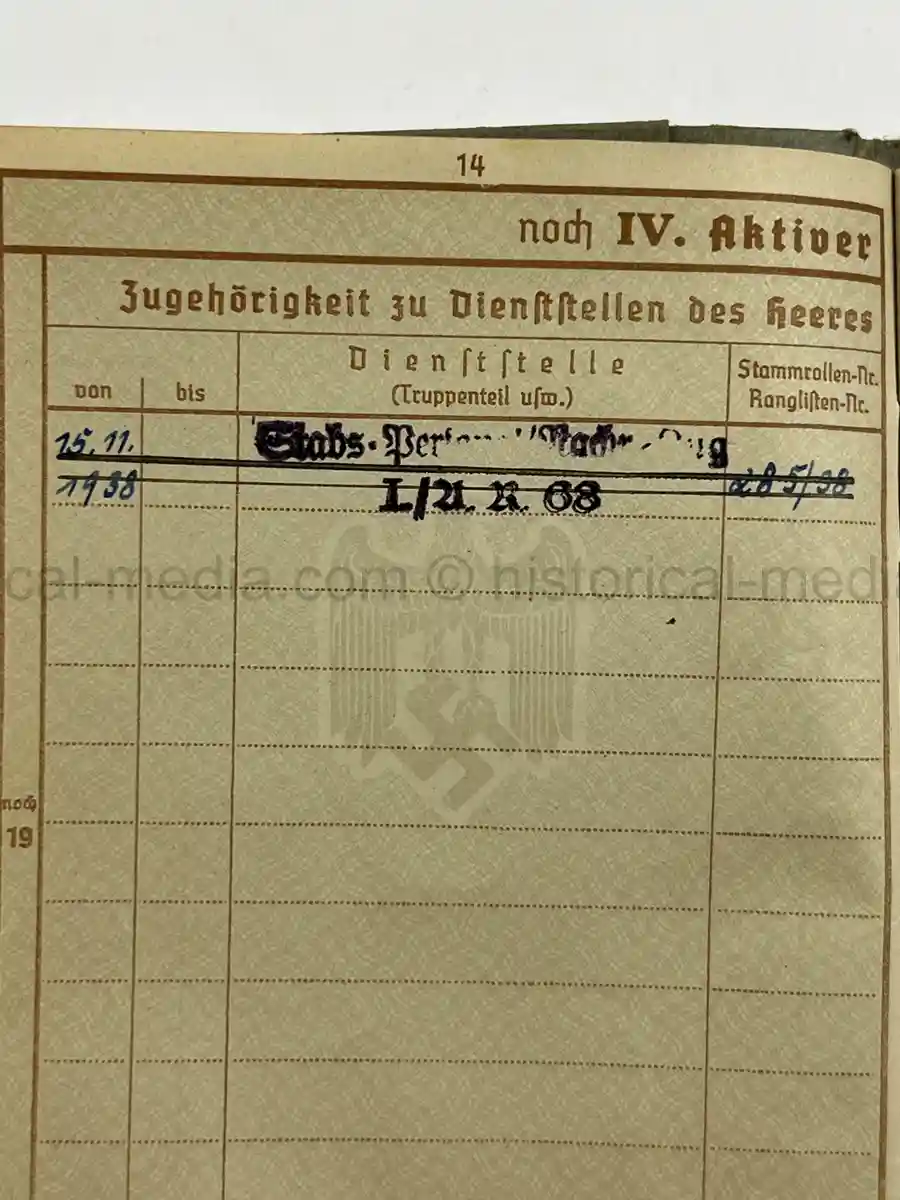
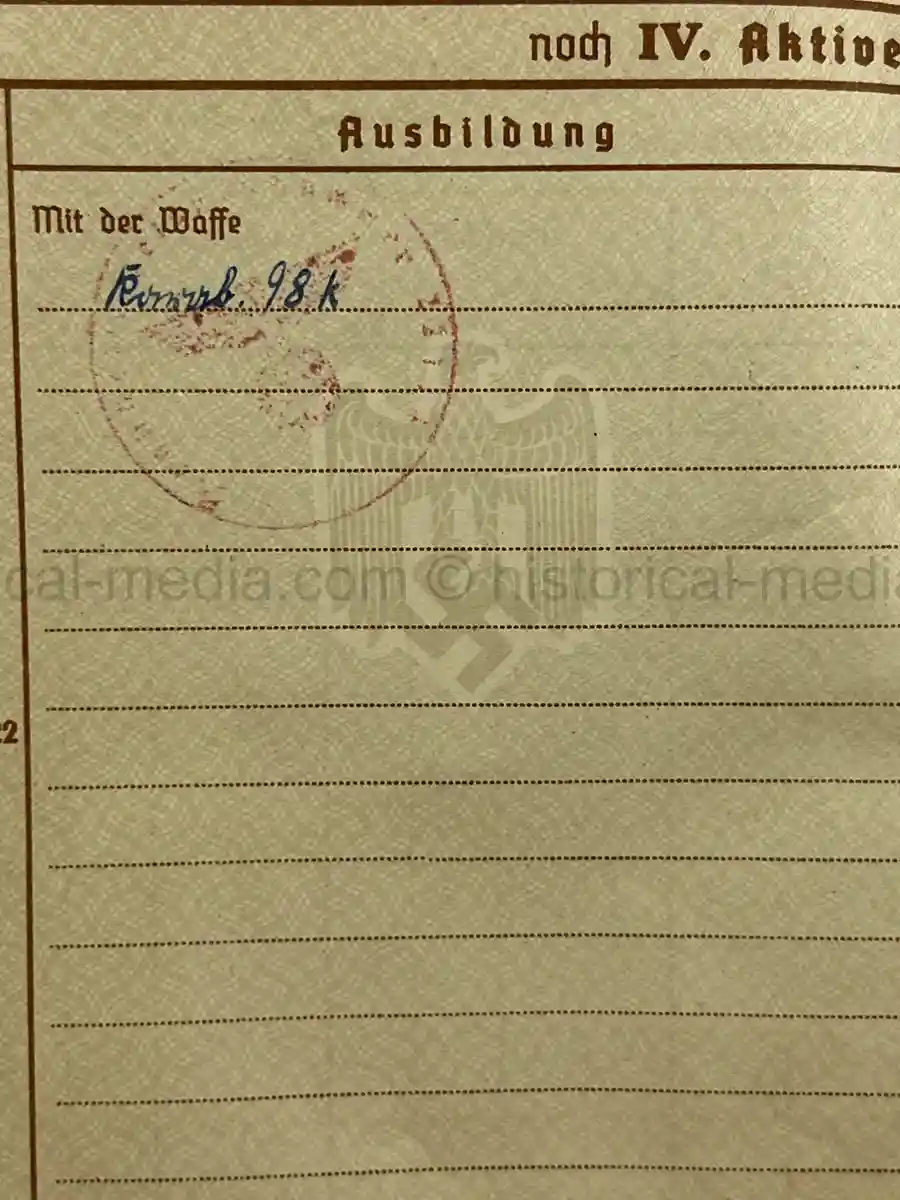
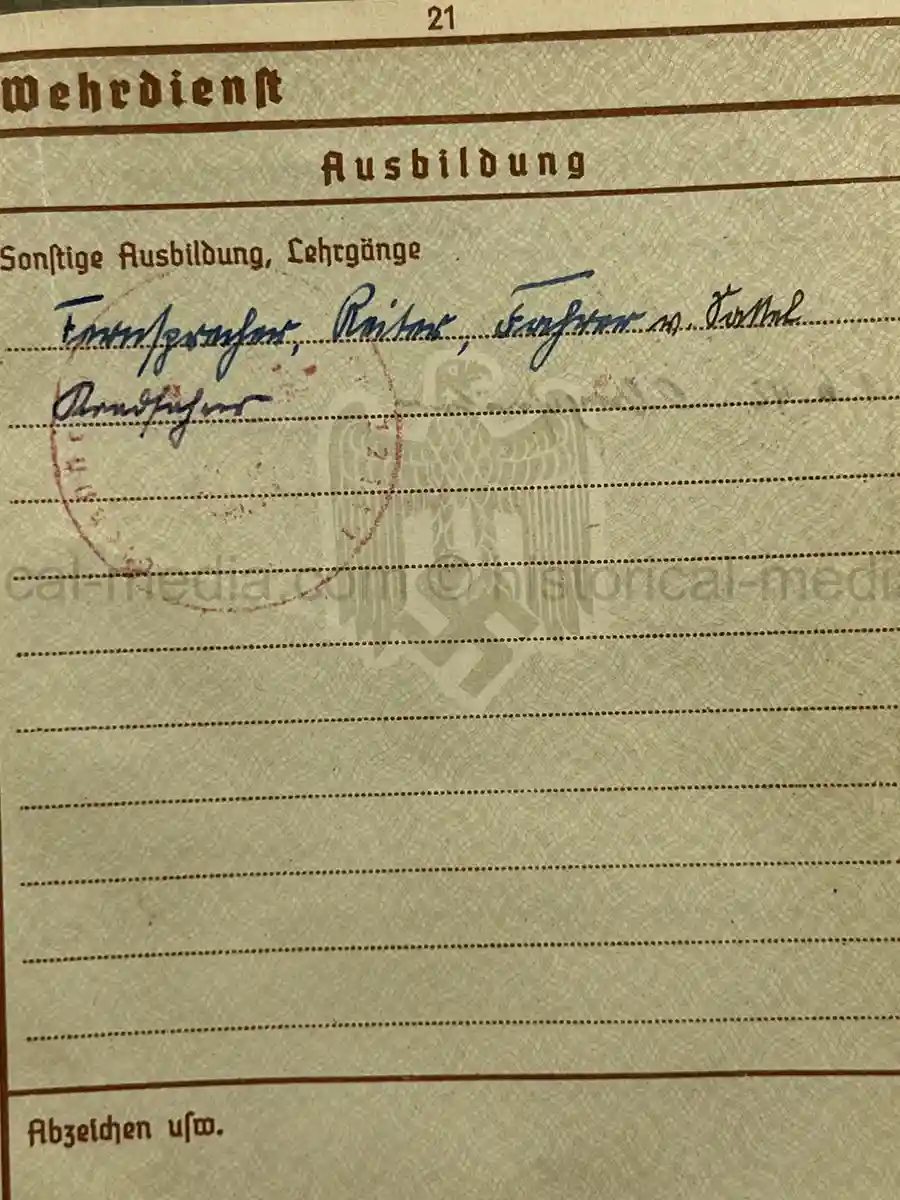
Zakrzewski entered military service on November 15, 1938, at Belgard, with the staff and signals platoon of I./Artillerie-Regiment 68, taking his military oath on November 24, 1938. His training included the Karabiner 98k, field telephone communications, horseback riding and handling horse-drawn military transport.
His recorded unit assignments include:
- 15.11.1938–09.10.1940 – Stab/Nachrichten-Zug I./Artillerie-Regiment 68.
- 10.10.1940–10.06.1941 – Nachrichten-Zug IV./Artillerie-Regiment 122.
- 11.06.1941–01.05.1943 – Stabsbatterie IV./Artillerie-Regiment 122.
- 02.05.1943–31.08.1943 – 2./Aufklärungs-Abteilung 122.
- 01.09.1943–08.12.1943 – 2./Divisions-Füsilier-Bataillon 122.
His assignments document the transition from artillery communications and staff duties to service with divisional reconnaissance and fusilier formations.
POLAND CAMPAIGN – 1939
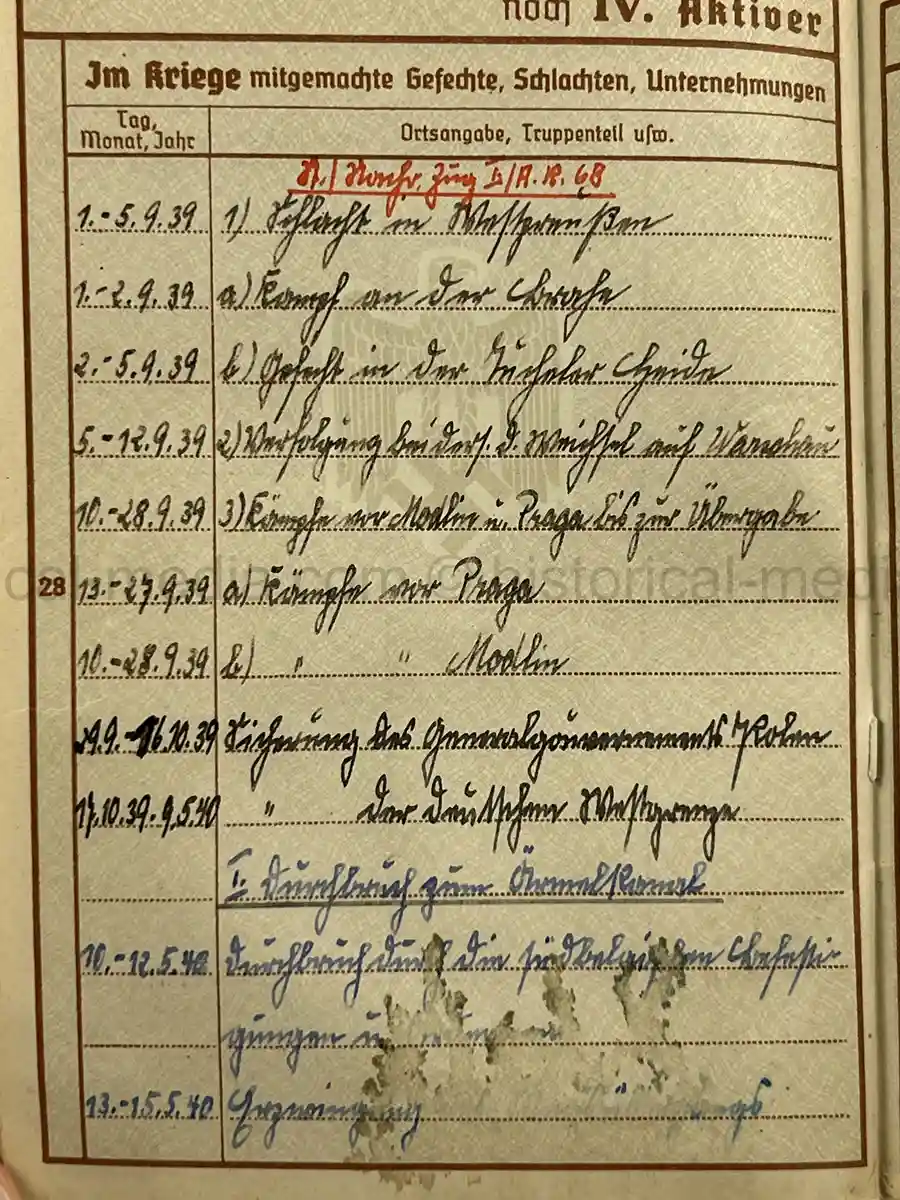
Detailed handwritten campaign entries document Zakrzewski’s participation in the invasion of Poland with Artillerie-Regiment 68. Entries include:
- September 1–5 – Battle in West Prussia.
- September 1–2 – Fighting along the Brahe River.
- September 2–5 – Fighting in the Tuchola Forest.
- September 5–12 – Advance along the Vistula toward Warsaw.
- September 10–28 – Fighting around Modlin and Praga.
- September 13–27 – Fighting at Praga, the eastern district of Warsaw.
- September 16–28 – Fighting around the fortress of MODLIN.
Further entries document occupation duties in Poland and subsequent security operations along Germany’s western frontier.
BELGIUM & FRANCE CAMPAIGN – 1940
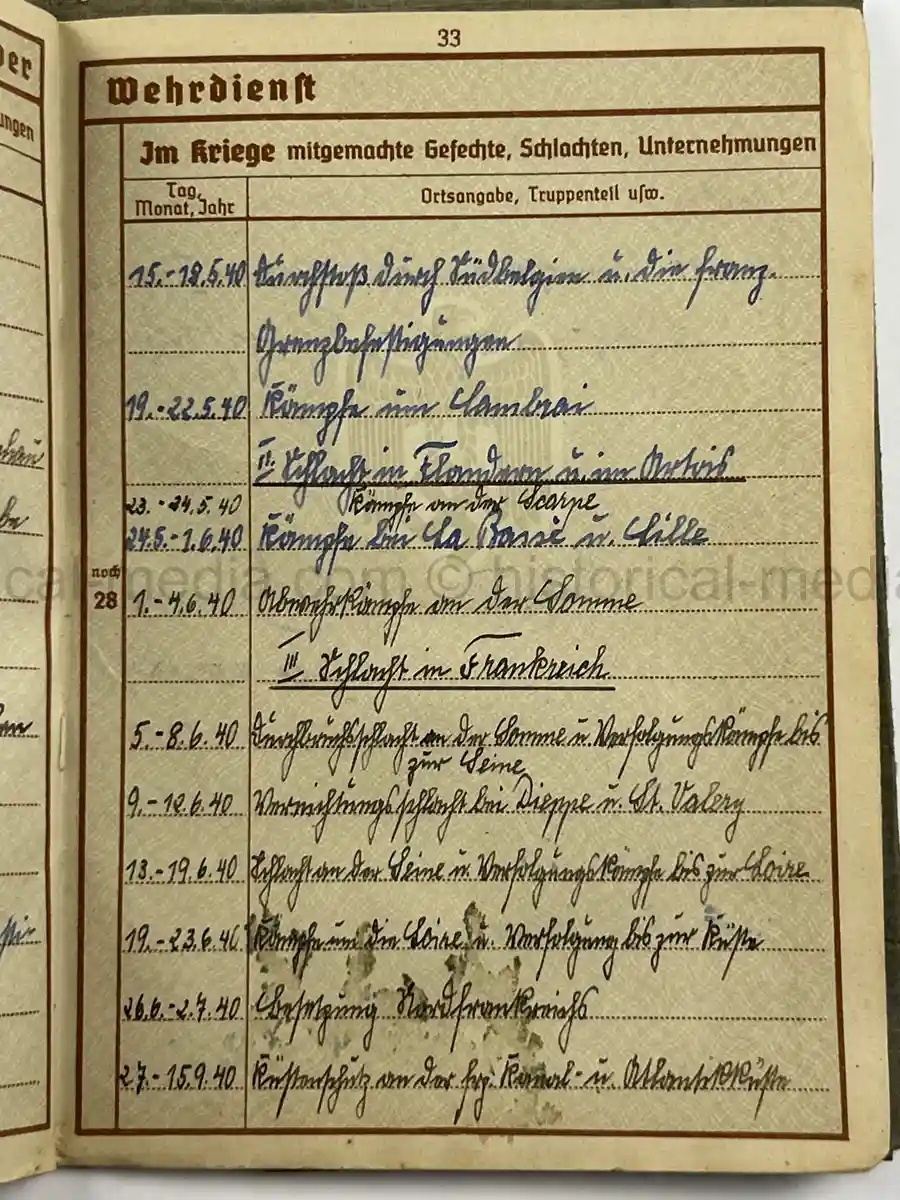
Extensive handwritten campaign entries document the Western Campaign, including the breakthrough of the southern Belgian frontier defenses, the advance through Belgium and northern France, and fighting around Cambrai from May 19–22, 1940.Especially interesting are the entries for the Battle of Flanders and Artois, including fighting along the Scarpe River and operations around La Bassée and Lille.
Further entries document:
- June 1–4 – Defensive battles along the Somme.
- June 5–8 – Breakthrough of the Somme positions and advance toward the Seine.
- June 9–12 – Encirclement battles near Dieppe and St. Valery.
- June 13–19 – Battle of the Seine and advance toward the Loire.
- June 19–23 – Fighting along the Loire and advance toward the coast.
- June 26–July 2 – Occupation of western France.
- July 2–September 15 – Coastal security duties along the English Channel and Atlantic coast.
In October 1940, Zakrzewski transferred to Artillerie-Regiment 122 of the newly established 122. Infanterie-Division, with which he would serve on the Eastern Front.
122. INFANTERIE-DIVISION – OPERATION BARBAROSSA & LENINGRAD – 1941
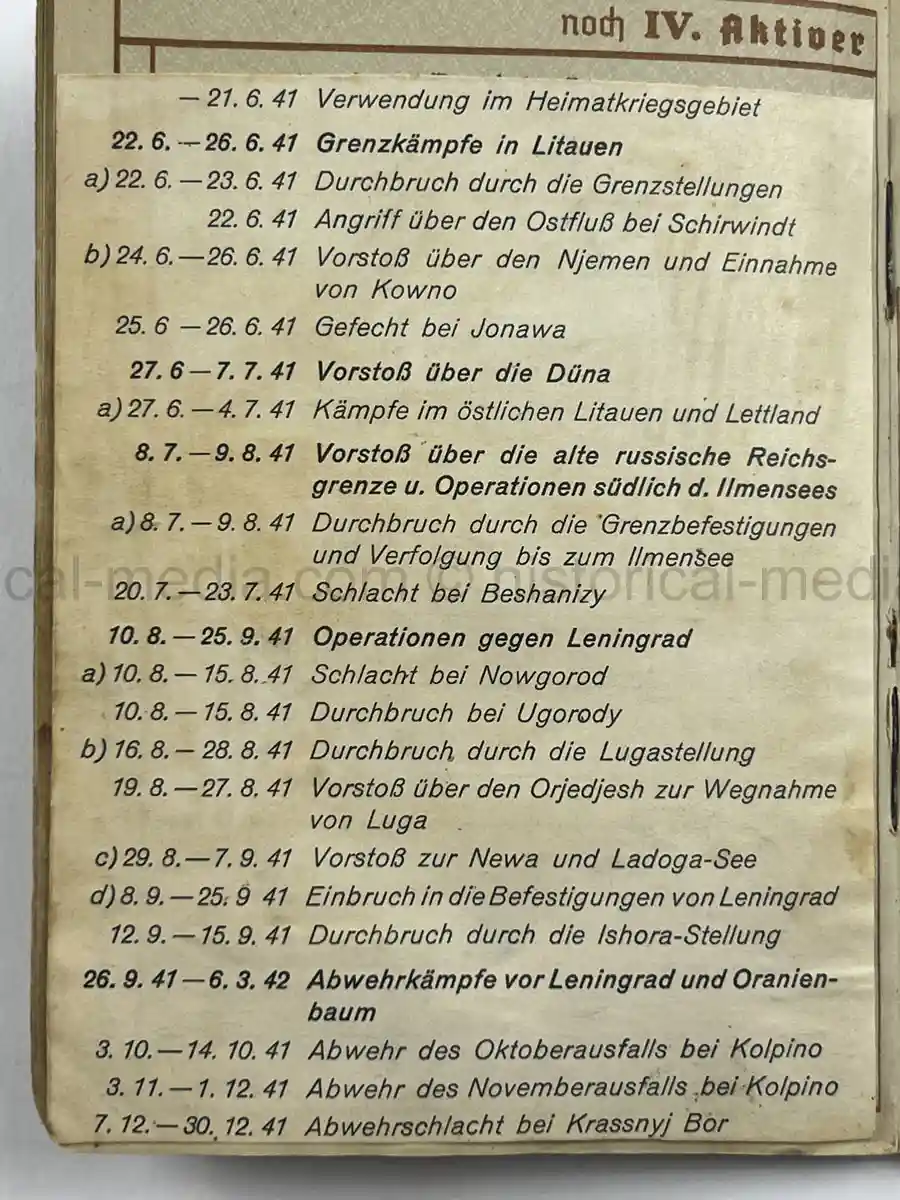
The 122. Infanterie-Division, formed in October 1940, served with Heeresgruppe Nord during the invasion of the Soviet Union. An excellent original printed campaign insert in the Wehrpass documents its operations beginning on June 22, 1941.
The detailed campaign entries include:
- June 22–26 – Frontier battles in Lithuania, including operations at Schirwindt, the crossing of the Niemen and capture of Kowno.
- June 25–26 – Fighting at Jonawa.
- June 27–July 7 – Advance across the Düna River and operations in Lithuania and Latvia.
- July 8–August 9 – Advance beyond the former Russian frontier and operations south of Lake Ilmen.
- July 20–23 – Battle of Beshanizy.
- August 10–15 – Battle of Novgorod and breakthrough at Ugorody.
- August 16–28 – Breakthrough of the Luga defensive positions.
- August 19–27 – Advance across the Orjedesh River and capture of Luga.
- August 29–September 7 – Advance toward the Neva River and Lake Ladoga.
- September 8–25 – Operations against the fortifications of LENINGRAD.
- September 12–15 – Breakthrough of the Ishora defensive positions.
- September 26, 1941–March 6, 1942 – Defensive battles before Leningrad and Oranienbaum.
Additional entries identify the Soviet counterattacks at Kolpino in October and November 1941 and the December 1941 defensive battles at Krasny Bor.
FIRST COMBAT WOUND – NOVEMBER 30, 1941
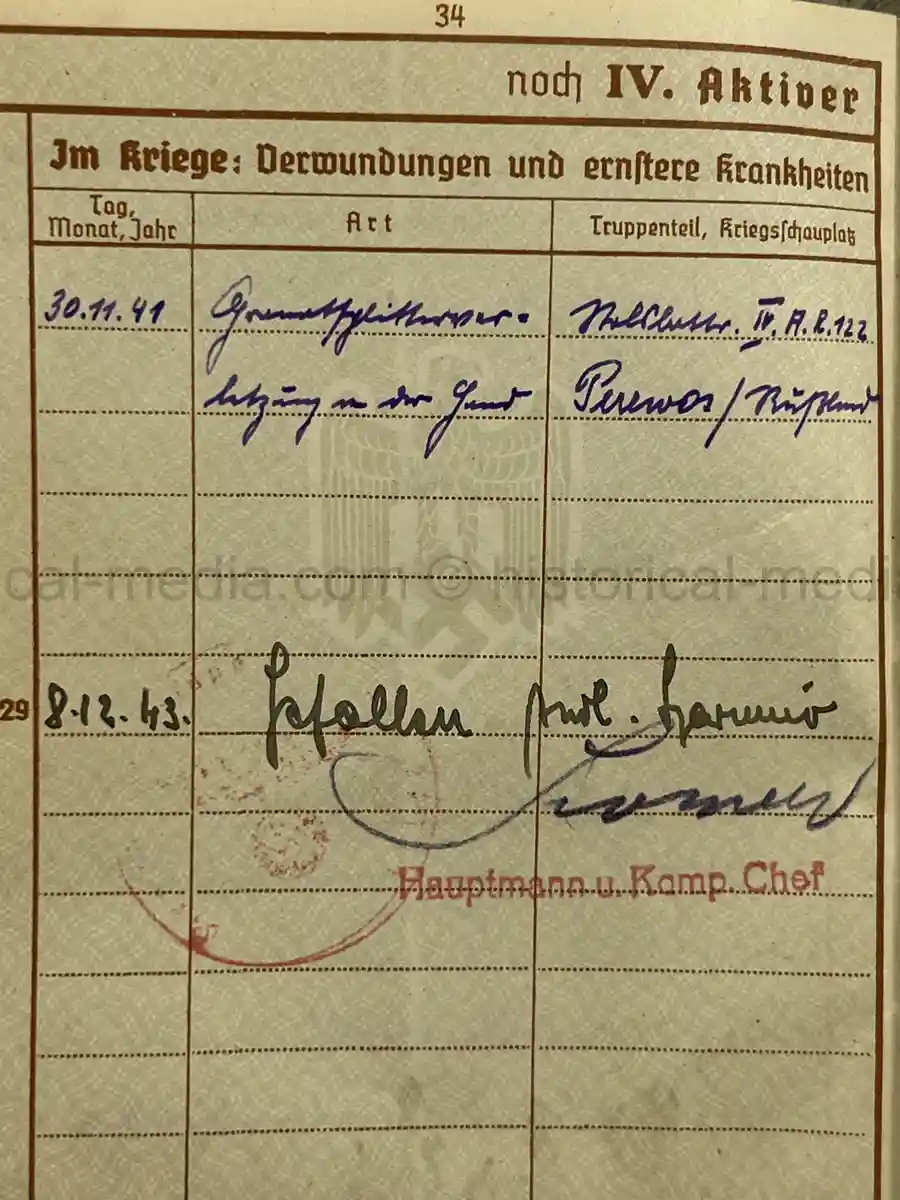
An entry on page 34 records Zakrzewski’s first combat wound on November 30, 1941, while serving with Stabsbatterie IV./Artillerie-Regiment 122. The handwritten entry describes a grenade splinter injury to the hand.He subsequently returned to military service and was awarded the Black Wound Badge on April 28, 1942.
DEMJANSK POCKET – 1942
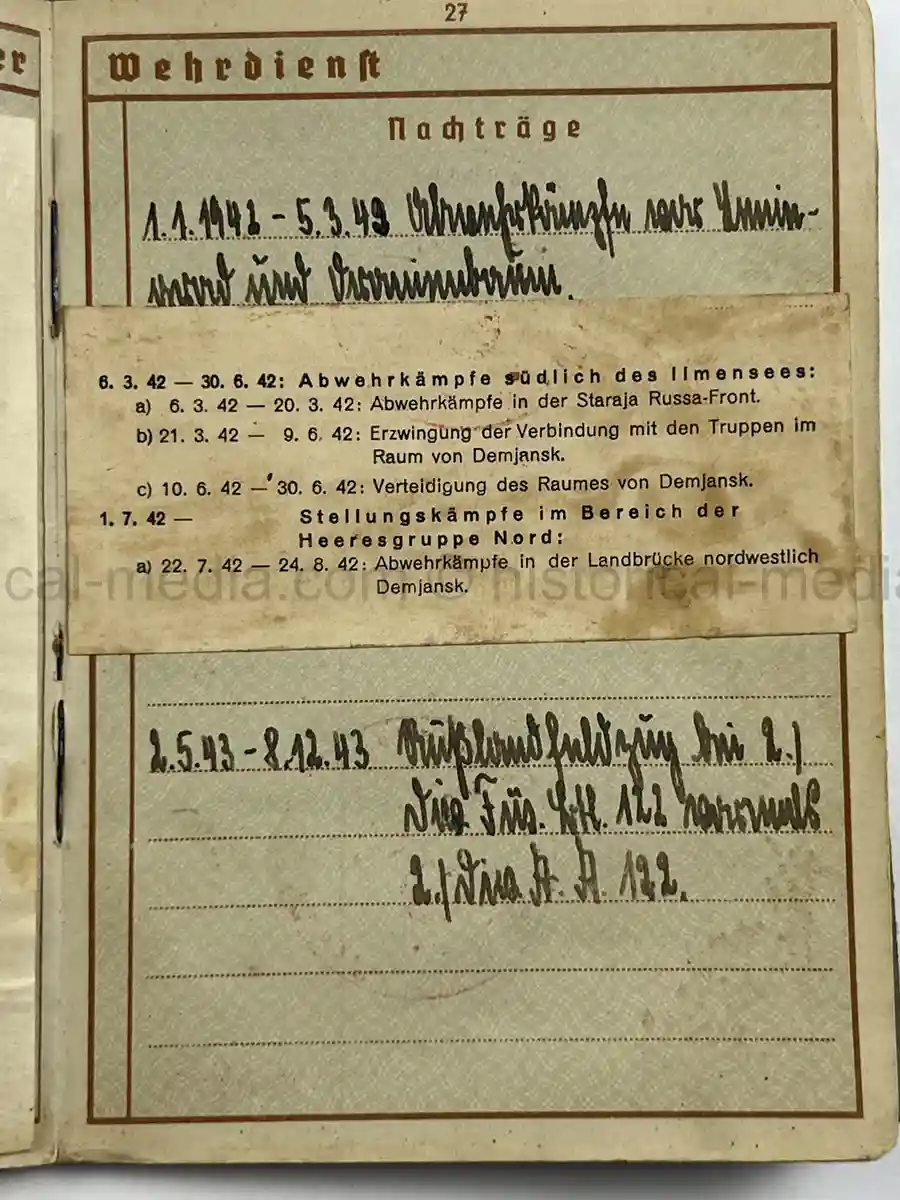
A further original printed campaign insert documents the division’s transfer from the Leningrad sector to the area south of Lake Ilmen in March 1942.
Of particular historical interest are the following entries:
- 06.03.1942–20.03.1942 – Defensive battles on the Staraja Russa front.
- 21.03.1942–09.06.1942 – Establishment of contact with the troops in the Demjansk region.
- 10.06.1942–30.06.1942 – Defense of the Demjansk region.
- From 01.07.1942 – Positional fighting in the operational area of Heeresgruppe Nord.
- 22.07.1942–24.08.1942 – Defensive battles in the land corridor northwest of Demjansk.
These entries directly document participation in operations to establish and maintain the land connection with German forces encircled in the DEMJANSK POCKET. The 122. Infanterie-Division participated in the relief operations associated with Operation Brückenschlag in the spring of 1942 and subsequently fought to maintain the narrow corridor connecting the pocket with the main German front.
RECONNAISSANCE & FÜSILIER SERVICE – NEWEL 1943
In May 1943, Zakrzewski transferred to 2./Aufklärungs-Abteilung 122, subsequently redesignated 2./Divisions-Füsilier-Bataillon 122 in September 1943. The 122. Infanterie-Division remained in the northern sector of the Eastern Front, participating in operations around Demjansk and Staraja Russa before being transferred to the Newel sector in the autumn of 1943. The Soviet capture of Newel in October 1943 created a dangerous penetration in the German front near the boundary between Heeresgruppen Nord and Mitte. Zakrzewski served as a Melder (messenger) with his company’s headquarters element during the subsequent fighting.
SECOND WOUND & KILLED IN ACTION – DECEMBER 8, 1943
The most historically significant accompanying document is an original wartime certified copy of a condolence letter addressed to Zakrzewski’s mother, dated January 6, 1944, and written by Leutnant Rudolf Herz, acting company commander.The letter describes how Zakrzewski was wounded by an infantry projectile in the right forearm on December 7, 1943, while carrying out his duties as a company messenger. His wound was initially described as slight.The following day, he was admitted to the Hauptverbandplatz (main dressing station) at Isotscha, west of Newel. On the evening of December 8, 1943, the dressing station was attacked by Soviet bombers. Zakrzewski was killed alongside other wounded soldiers and members of his company.The letter further records his burial in the military cemetery at Isotscha and confirms that he was awarded the Iron Cross 2nd Class after his death.The document bears an official certification stamp dated February 17, 1944. The circumstances of his death are particularly noteworthy, as they establish that he survived his initial combat wound only to be killed the following day during an attack on the medical facility.
PROMOTIONS
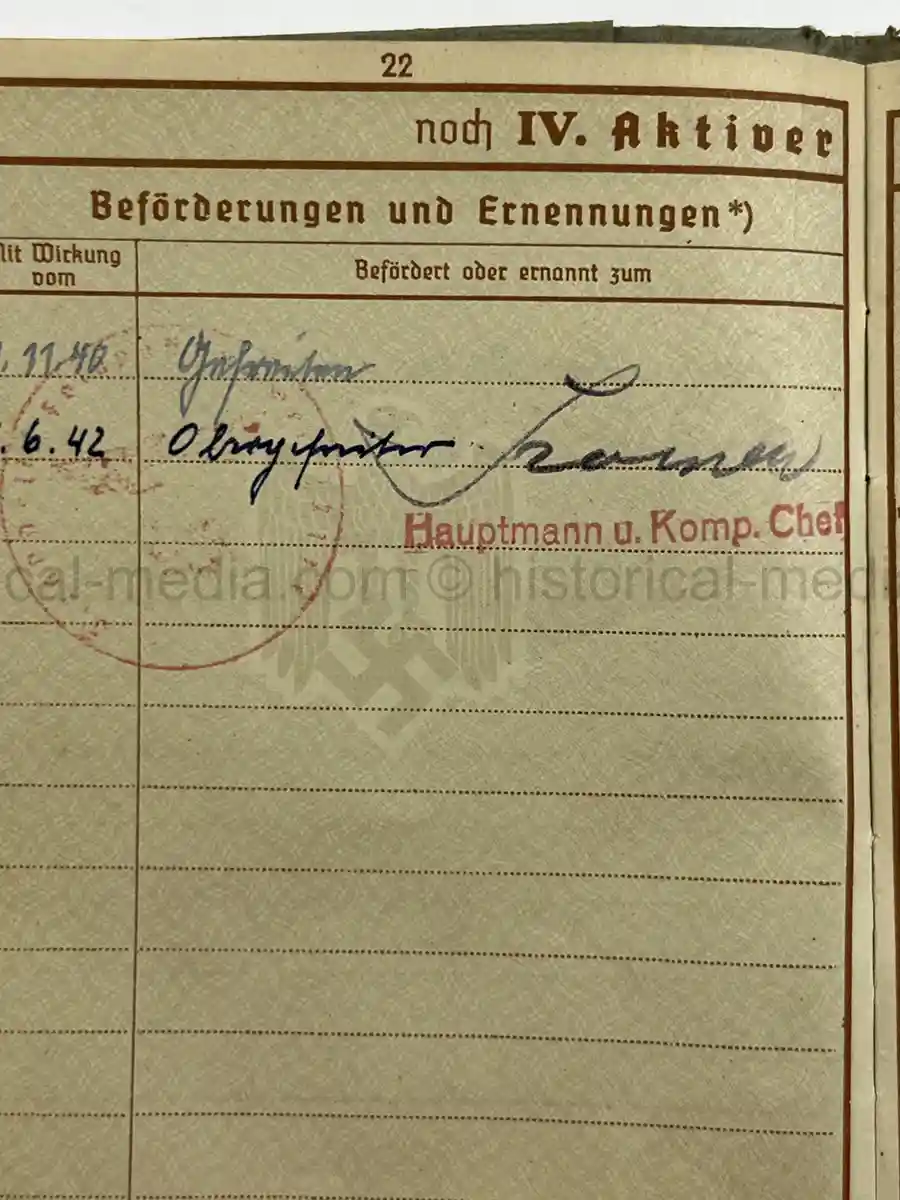
- 01.11.1940 – Gefreiter.
- 01.06.1942 – Obergefreiter.
AWARDS & DECORATIONS
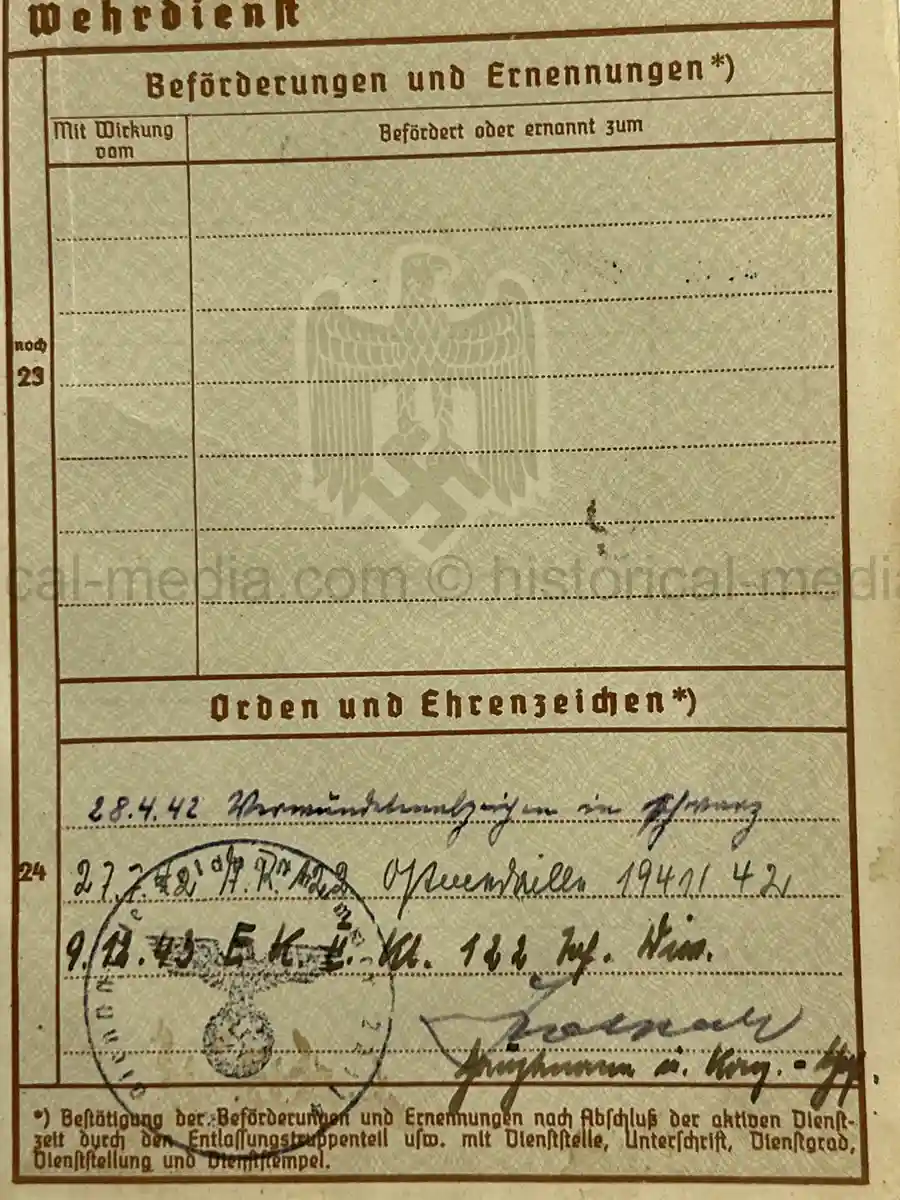
- 28.04.1942 – Verwundetenabzeichen in Schwarz – Black Wound Badge.
- 27.07.1942 – Ostmedaille – Eastern Front Medal.
- 09.12.1943 – Eisernes Kreuz II. Klasse – Iron Cross 2nd Class, POSTHUMOUSLY awarded one day after his death.
An extensively documented KIA Wehrpass grouping covering the Polish and Western Campaigns, the offensive against Leningrad, the relief of the Demjansk pocket and the subsequent fighting around Newel. Particularly noteworthy are the detailed original divisional campaign inserts, two documented combat wounds, the posthumous Iron Cross award, accompanying uniform portrait and the unusually informative death notification letter documenting the precise circumstances of his death and place of burial.
“`